

Shorter is better
What research found: Kids have limited attention spans. One study of 6.9 million video views showed that shorter videos almost always had higher engagement than longer ones (Guo and colleagues, 2014).
What your child sees: Each lesson takes under 3 minutes. It teaches one skill from start to finish, then stops.
One new idea at a time
What research found: We can only hold a few new things in mind at once. When a lesson adds more than that, learning drops. Breaking a lesson into small steps helps, especially when the idea is new (Sweller, 1988; Mayer and Moreno, 2003).
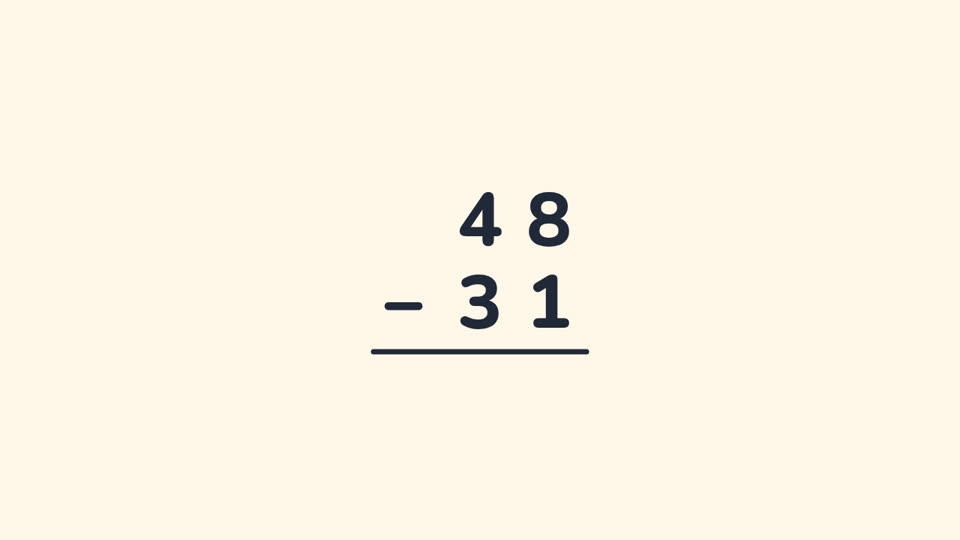
What your child sees: Each moment of the video adds just one thing. First the problem appears on its own. Then, in the next step, the blocks that show it.
From blocks to numbers
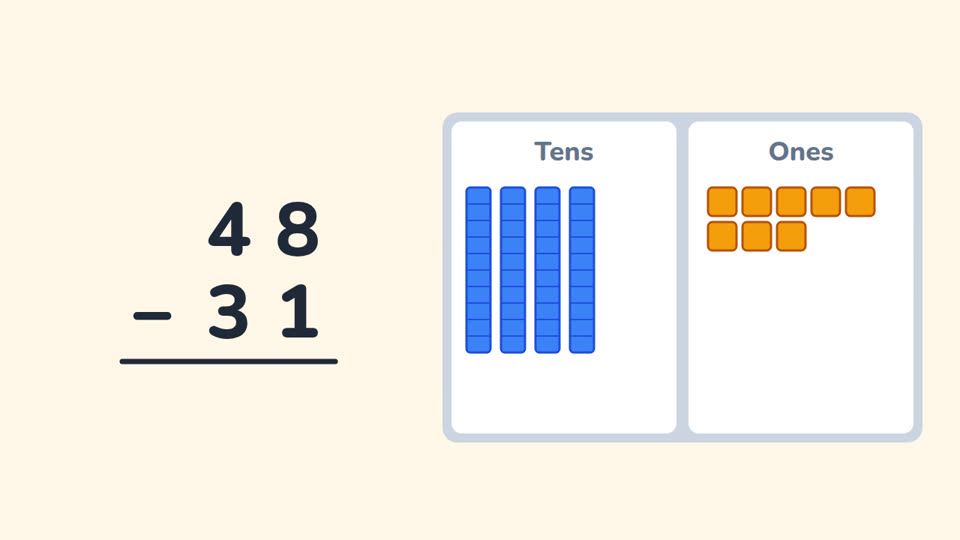
What research found: Children understand a math idea more deeply when they first see it with real objects and then connect those objects to the written numbers (Fyfe and colleagues, 2014).
What your child sees: The written problem stays on the left. Blocks, dots or a number line sit on the right. Every step happens in both places at once, so the numbers always mean something your child can count.
Keep attention focused
What research found: Music, decorations and other extras make learning harder. Extra visual elements often pull attention from the substance of the video itself (Mayer and colleagues, 2001; Mayer and Moreno, 2003).
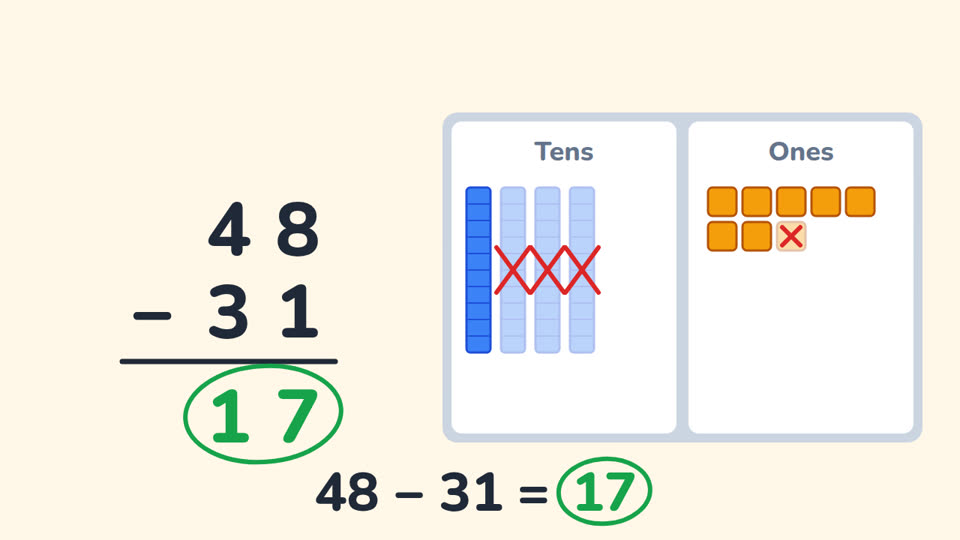
What your child sees: A clean screen with no music and no background clutter. Color is used only when it means something. Every final answer is clearly marked: it turns green and gets a circle around it, the same way your child can show their work on paper.
Hear it and see it at the same moment
What research found: People learn best when words and pictures arrive together, explaining the same thing at the same time, rather than one after the other (Mayer, 2009).
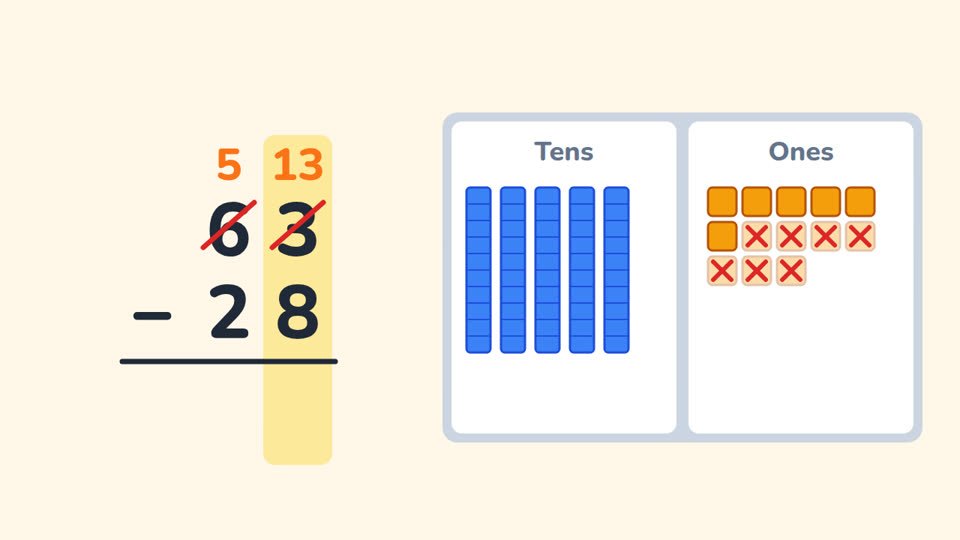
What your child sees: When I say "take away one," a block is crossed out right then. When I count, one dot appears on each number, at a pace a young child can follow.
Watch a few, then try one
What research found: Studying fully worked examples helps beginners more than jumping straight into solving problems. It works best when the examples get a little harder each time and then hand the work over to the learner (Sweller and Cooper, 1985; Atkinson and colleagues, 2000).
What your child sees: Every lesson has three examples. The first is the simplest. The second adds the tricky part. The third is the hardest, and I say "Now you try."
Questions that keep them thinking
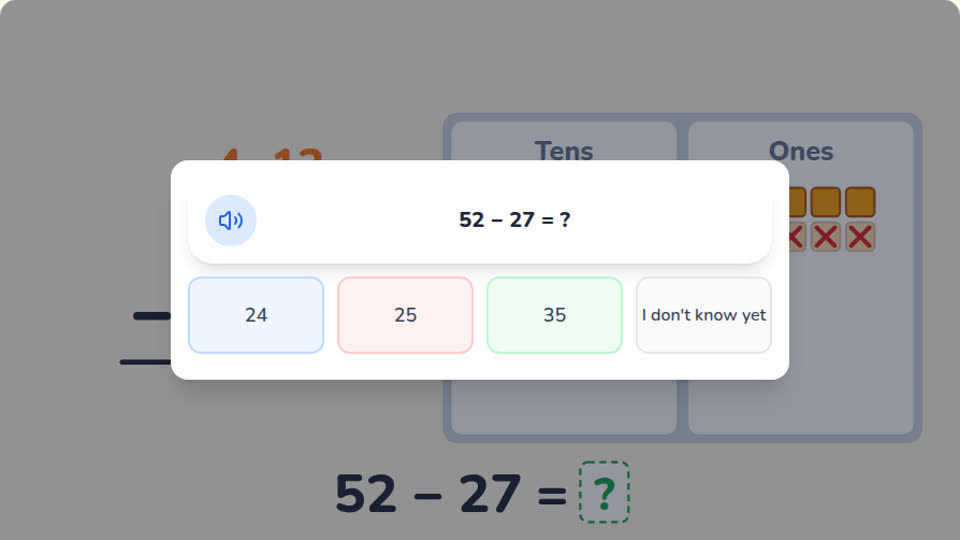
What research found: Short questions during a video keep minds from wandering and improve what learners remember afterward. Trying to recall an answer strengthens memory more than watching again. Making a guess before seeing the answer helps too, even when the guess is wrong (Szpunar and colleagues, 2013; Vural, 2013; Roediger and Karpicke, 2006; Richland and colleagues, 2009).
What your child sees: The video pauses during each problem to check the student's understanding. This keeps kids engaged and helps them retain the video content.
Kind, honest feedback
What research found: The most useful feedback is about the task: was the answer right, and what comes next. General praise does little for learning (Hattie and Timperley, 2007).
What your child sees: A right answer gets a quick celebration. If your child is stuck, there's no pretend praise, just "That's okay – the answer is 17," and the lesson shows why.
A friendly voice, talking to your child
What research found: Learners try harder and remember more when a lesson talks to them in a warm, everyday voice rather than a formal one (Mayer and colleagues, 2004).
What your child sees: I always welcome students into the lesson, use kid-friendly language, and summarize key points in terms that children understand.
How Bobby's Math Club can help
Bobby's Math Club brings these research principles to life, which is why I use it with my own kids every week. Here's what your child gets, from Pre-K through 5th grade:
- Short video lessons. One idea at a time, with questions along the way.
- Practice right after. Unlimited questions on the same skill, read aloud, with feedback after every answer.
- Help when they're stuck. The answer and a short explanation, so a miss turns into learning.
Questions parents ask
How long should a math video be for kids?
Short. Kids have limited attention spans, and viewers watch far more of a short video than a long one. Our lessons take under 3 minutes and teach one skill from start to finish.
Should my child watch the video before practicing?
For a new skill, yes. Children learn faster when they're shown how first. Practicing right after the video, while it's fresh, helps the skill stick.
Can I watch with my child?
Please do. When the video stops for a question, let your child answer first, then talk about it together. Asking "How did you know?" is a great way to hear their thinking.
What if my child gets a question in the video wrong?
That's part of learning. Trying an answer before seeing it helps children remember, even when the try is wrong. The video shows the answer and then explains it.
Why do the videos look so simple?
On purpose. Music, decorations and extra pictures pull attention away from the math. A clean screen keeps your child's attention on the idea that matters.
Can a video replace practice?
No. A video shows your child how. Practice, with feedback after every answer, is what turns "I sort of get it" into "I know this."
What is Bobby's Math Club?
A math practice app for Pre-K through 5th grade. Your child practices about five minutes at a time, at just the right level, gets feedback after every answer and is shown how when they're stuck. Every question is read aloud, and unlimited practice is free.
Research behind this guide
- Atkinson, R. K., Derry, S. J., Renkl, A., & Wortham, D. (2000). Learning from examples: Instructional principles from the worked examples research. Review of Educational Research, 70(2).
- Brame, C. J. (2016). Effective educational videos: Principles and guidelines for maximizing student learning from video content. CBE—Life Sciences Education, 15(4).
- Fyfe, E. R., McNeil, N. M., Son, J. Y., & Goldstone, R. L. (2014). Concreteness fading in mathematics and science instruction: A systematic review. Educational Psychology Review, 26(1).
- Guo, P. J., Kim, J., & Rubin, R. (2014). How video production affects student engagement: An empirical study of MOOC videos. Proceedings of the First ACM Conference on Learning @ Scale.
- Hattie, J., & Timperley, H. (2007). The power of feedback. Review of Educational Research, 77(1).
- Mayer, R. E. (2009). Multimedia Learning (2nd ed.). Cambridge University Press.
- Mayer, R. E., Fennell, S., Farmer, L., & Campbell, J. (2004). A personalization effect in multimedia learning: Students learn better when words are in conversational style rather than formal style. Journal of Educational Psychology, 96(2).
- Mayer, R. E., Heiser, J., & Lonn, S. (2001). Cognitive constraints on multimedia learning: When presenting more material results in less understanding. Journal of Educational Psychology, 93(1).
- Mayer, R. E., & Moreno, R. (2003). Nine ways to reduce cognitive load in multimedia learning. Educational Psychologist, 38(1).
- Richland, L. E., Kornell, N., & Kao, L. S. (2009). The pretesting effect: Do unsuccessful retrieval attempts enhance learning? Journal of Experimental Psychology: Applied, 15(3).
- Roediger, H. L., & Karpicke, J. D. (2006). Test-enhanced learning: Taking memory tests improves long-term retention. Psychological Science, 17(3).
- Sweller, J. (1988). Cognitive load during problem solving: Effects on learning. Cognitive Science, 12(2).
- Sweller, J., & Cooper, G. A. (1985). The use of worked examples as a substitute for problem solving in learning algebra. Cognition and Instruction, 2(1).
- Szpunar, K. K., Khan, N. Y., & Schacter, D. L. (2013). Interpolated memory tests reduce mind wandering and improve learning of online lectures. Proceedings of the National Academy of Sciences, 110(16).
- Vural, Ö. F. (2013). The impact of a question-embedded video-based learning tool on e-learning. Educational Sciences: Theory and Practice, 13(2).