
Our Story
It started with a kindergartner, his dad, and a book of math problems. Here's how Bobby tells it:
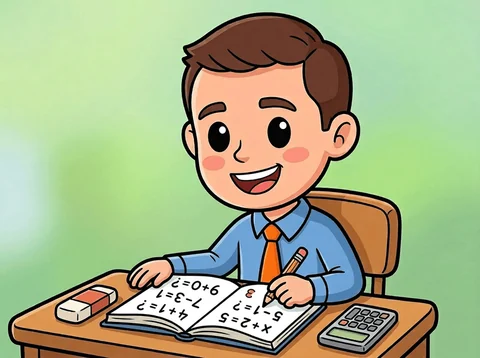
A book of problems, with my dad
When I was in kindergarten, my parents bought me a book of math problems. Every day I sat with my dad and did a few. I loved the time with him, and I loved getting the problems right.

Confidence that lasted
No matter how hard math got, I thought back to those problems with my dad and knew I could learn it. I went on to Princeton University, where I studied public policy with a quantitative focus and took math courses along the way.
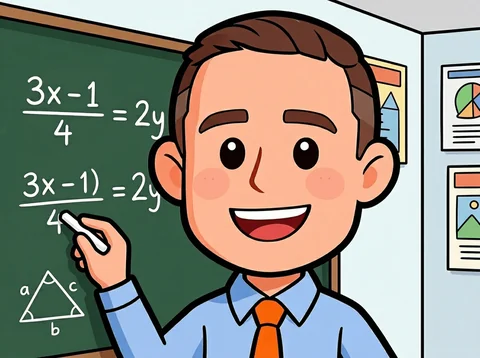
Sharing my love of math
After college, I realized that I wanted to share my love of math with others. I became a math teacher, wrote a book, and co-founded a nonprofit called the Modern Classrooms Project to train math teachers worldwide.

Late nights, for my kids and yours
When I had my own kids, I thought back to those problems I solved with my dad. Could I create something like that for my kids, and maybe for other kids too? After my kids went to bed, I stayed up late building it. So Bobby's Math Club was born.
Bobby's Math Club provides unlimited free practice for every kid.
Bobby believes all children can succeed in math. With digital and paper practice adapted to your child's levels, along with kid-friendly videos and parent-friendly reports, his online math club helps PK-5 students build lifelong skills and confidence in just a few minutes per day.
What the research says
Early math matters most
A child's math knowledge at the start of school is one of the best signs of how they'll do later — even stronger than early reading.
The benefits last
Early math skills predict outcomes into adulthood, from high school courses to college to career success.,
Grown-ups make the difference
Kids whose families do math together at home — even briefly and informally — tend to have stronger math skills.
You don't have to be a math teacher. You just have to show up.
Duncan, G. J., Dowsett, C. J., Claessens, A., Magnuson, K., Huston, A. C., Klebanov, P., & Japel, C. (2007). School readiness and later achievement. Developmental Psychology, 43(6), 1428–1446.
The researchers combined six long-term studies that measured children's skills when they started school, around age 5, and their achievement again between ages 7 and 14. Early math skills were the strongest predictor of later achievement, ahead of early reading and attention.
Ritchie, S. J., & Bates, T. C. (2013). Enduring links from childhood mathematics and reading achievement to adult socioeconomic status. Psychological Science, 24(7), 1301–1308.
This study followed thousands of people born in Britain in 1958, from childhood to age 42. Children with stronger math and reading skills at age 7 were better off as adults, even after accounting for their family's circumstances at birth and their intelligence.
Davis-Kean, P. E., Domina, T., Kuhfeld, M., Ellis, A., & Gershoff, E. T. (2022). It matters how you start: Early numeracy mastery predicts high school math course-taking and college attendance. Infant and Child Development, 31(2), e2281.
This study followed 1,364 American children from age 4½ into young adulthood. Children who hadn't yet mastered early number skills before kindergarten, like counting and simple adding and subtracting, were more often placed in lower-level math classes in high school, and were less likely to go to college.
Daucourt, M. C., Napoli, A. R., Quinn, J. M., Wood, S. G., & Hart, S. A. (2021). The home math environment and children's math achievement: A meta-analysis. Psychological Bulletin, 147(6), 565–596.
The researchers brought together 64 studies of the math children meet at home: the activities, the talk, and the attitudes. Across those studies, children whose families did more math at home tended to have stronger math skills. The link is small, but it held up across many different families and studies.
Our team
Designed for kids and their parents, by parents and their kids.