
Draw picture graphs and bar graphs
Graphs are one of the most useful ways your child will learn to make sense of information, in science class, in the news, and in everyday life. Answering questions about a graph also gives practice with adding and comparing. In 3rd grade, graphs use scales where one picture or square stands for several items, such as 2 or 5, so a solid start now matters.
In this video, your child will learn to make picture graphs and bar graphs.
The lesson stops at each question for your child's answer.
Three problems, each a little harder
Each problem is worked step by step. Your child will solve the last one before Bobby shows how.
Example 1
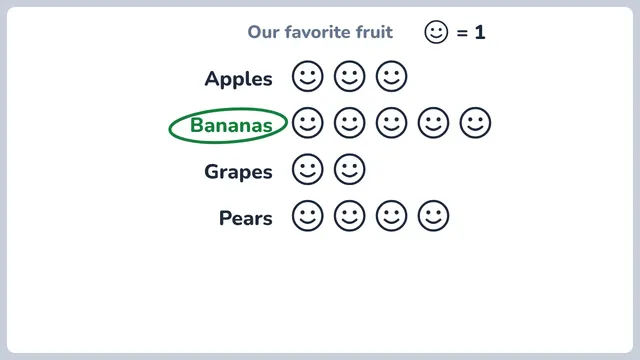
Which fruit did the most children choose?
Example 2
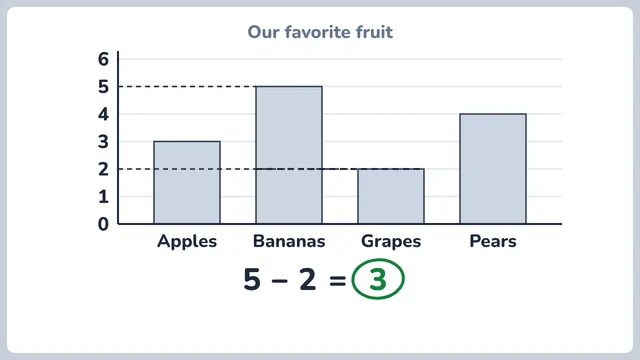
How many more children chose bananas than grapes?
Your child's turn
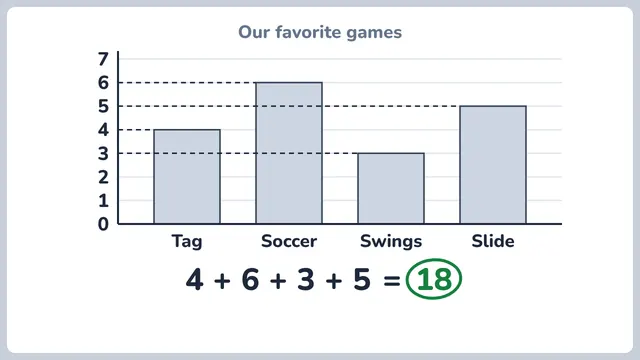
How many children voted in all?
The three key steps
- 1Longest or tallest: the most.
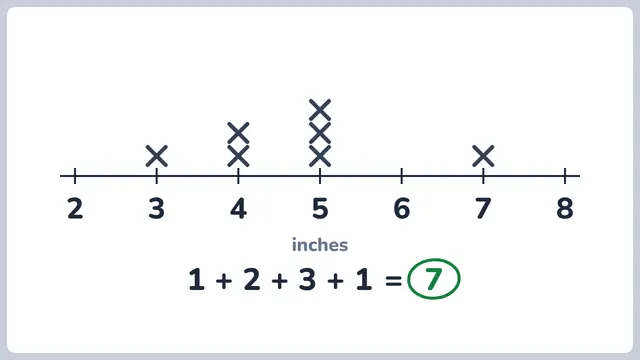
- 2Add to find how many in all.
- 3Subtract to find how many more.
Mistakes to listen for
- Drawing bars of uneven widths, or starting them at different heights, so some categories look bigger than they are.
- Reading a bar's height from the wrong spot, such as the top of the label, and ending up one off.
- Answering a compare question with a total, saying 10 for how many more apples than grapes when there are 6 and 4.
The lesson shows every step, so your child sees why it works. Read our parent's guide to making and reading picture graphs and bar graphs →
Is your child ready to practice what they've learned?
Bobby's Math Club offers unlimited practice for free.
Join the clubMore kid-friendly lessons
More 2nd grade Measurement & Data, with questions your child answers along the way.
Questions parents ask
Does my child need an account to watch?
No. You can watch this on any device at any time. If your child would like to practice making and reading picture graphs and bar graphs, and you'd like parent-friendly reports on your child's progress and growth, you can join Bobby's Math Club for unlimited free practice.
What happens when my child answers a question?
A right answer gets a cheer, and the lesson carries on. If your child isn't sure, they can tap "I don't know yet", and Bobby gives the answer and shows another example. Nothing is scored or stored.
Is this the same lesson that's on YouTube?
Yes. Here, the lesson stops at each question and waits for your child to answer. On YouTube, each question stays on screen for a few seconds, and then the lesson plays on.
Where can I learn more?
There's a short, kid-friendly lesson like this one for every Pre-K to 5th grade math skill, all in our video library. Our parent's guide to making and reading picture graphs and bar graphs has more on where kids get stuck and how you can help at home. In the club, your child practices at just the right level, about five minutes a day, and you get parent-friendly reports as they grow. Learn more about how it works →
Practice making and reading picture graphs and bar graphs
Questions at your child's level, about five minutes a day, on making and reading picture graphs and bar graphs and whatever PK-5 skills they need to develop. Unlimited practice, free forever.
Join the club