
Everyday Mathematics Grade 3, Unit 1: Math Tools, Time, and Mass
In this unit, your child starts third grade with the tools of math: reading clocks to the minute, measuring mass in grams and kilograms, measuring liquids in liters, and adding and subtracting numbers up to 1,000. These skills build careful habits for measuring and checking. Next come number stories and arrays, where adding and subtracting meet multiplication.

By Robert “Bobby” BarnettMath teacher, parent, and founder of Bobby’s Math Club
What is my child learning in Unit 1?
- Reading a clock with hands to the exact minute and finding elapsed time, the time that passes, such as from 3:45 to 4:10. Learn more about telling time to the minute: Telling time to the minute · Learn more about working out how many minutes have passed
- Estimating and measuring mass, how heavy something is, in grams and kilograms, and liquid volume in liters. Learn more: Weighing things and measuring liquids
- Adding and subtracting within 1,000, regrouping, or trading 10 ones for 1 ten, whenever a place needs it. Learn more about adding within 1,000: Adding within 1,000 · Learn more about subtracting within 1,000
Sample questions to try together
These are real questions from our practice. Tap the speaker to hear one read aloud, or the light bulb for a hint, and talk about the answer together.
Question 1 of 3
The school play starts 20 minutes after the time shown on the clock. What time does the school play begin?
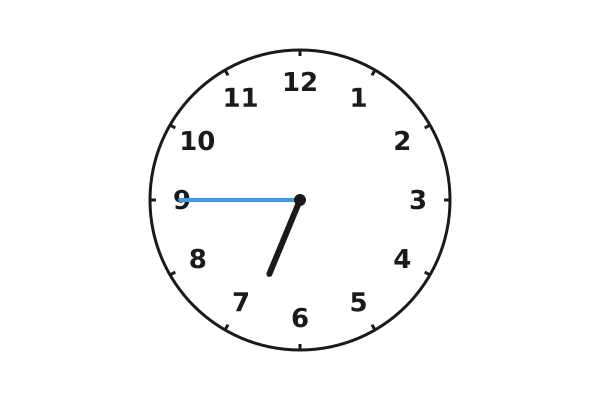
- 6:25 p.m.
- 7:05 p.m.
- 7:00 p.m.
How you can help
- Ask your child to read a clock with hands at breakfast, then figure out how many minutes until you leave, such as from 7:42 to 8:00, which is 18 minutes.
- Pick up two packages at the store, such as a 450-gram box of crackers and a 1-kilogram bag of rice, and have your child guess which has more mass before reading the labels.
- Find the difference between two page numbers in a chapter book, such as page 312 and page 147, and then check the answer by adding it back to 147.
Where kids can get stuck
- Adding minutes as if an hour had 100, so 3:45 plus 25 minutes becomes 3:70 instead of 4:10.
- Picking a unit that does not fit, such as guessing a backpack has a mass of 3 grams instead of 3 kilograms.
- Subtracting the smaller digit from the larger in each place, so 503 - 267 comes out as 364 instead of 236.
Practice makes perfect
Bobby's Math Club has practice problems that adapt to your child’s level, each with a detailed explanation and an easy-to-follow video, so your child can build confidence in these skills one step at a time.
Words your child will hear
- minute hand
- The long hand on a clock that points to the minutes.
- elapsed time
- How much time passes from the start of something to the end.
- a.m. and p.m.
- A.m. is from midnight to noon; p.m. is from noon to midnight.
- mass
- How heavy something is, measured in grams or kilograms.
- gram
- A small unit of mass; a paper clip is about 1 gram.
- kilogram
- A unit of mass equal to 1,000 grams; a big dictionary is about 1 kilogram.
- liter
- A unit of liquid volume; a large water bottle holds about 1 liter.
- regroup
- To trade 10 ones for 1 ten, or 10 tens for 1 hundred, and back.
- place value
- The value a digit has because of its place, like the 4 in 470 meaning 4 hundreds.
Want to help your child master time, mass, and adding?
In Bobby's Math Club, your child practices these skills at just the right level, with a hint when they need one, a clear explanation after every question, and kid-friendly videos. Unlimited practice is free.
Join the club
Written by Robert “Bobby” Barnett
Bobby is an award-winning math teacher, the author of Meet Every Learner’s Needs, and the father of two elementary-school math learners. He uses Bobby’s Math Club with his own kids a few times every week. Learn more or contact Bobby.
Which math standards does Everyday Mathematics Grade 3 Unit 1 cover?
Everyday Mathematics Grade 3 Unit 1 covers these math standards. Each one links to what it means, sample questions, and teaching strategies.
For teachers: Unit names and order vary between editions and districts, so your school’s own materials have the exact sequence. Learn how Bobby's Math Club can help your students grow.