
Working out how many minutes have passed
In 3rd grade, children learn to find how many minutes pass between two times, like 3:45 to 4:10; to find when something starts or ends; and to solve story problems that add or subtract minutes.

By Robert “Bobby” BarnettMath teacher, parent, and founder of Bobby’s Math Club
Try these with your child
These are real questions from our 3rd grade practice. Tap the speaker to hear one read aloud, or the light bulb for a hint, and talk about the answer together.
Question 1 of 3
The school play starts 20 minutes after the time shown on the clock. What time does the school play begin?
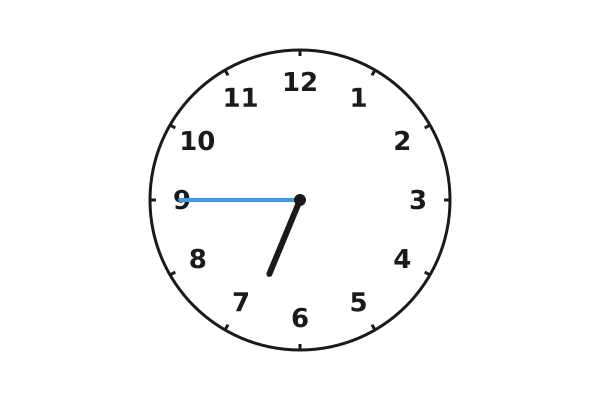
- 6:25 p.m.
- 7:05 p.m.
- 7:00 p.m.
Why this matters
Being able to work out elapsed time, the minutes that pass between two moments, helps your child plan ahead and make sense of a wait, like how long until dinner. It also stretches their adding and subtracting, because an hour holds 60 minutes, not 100. In 4th grade, this grows into problems with hours and minutes together. It shows up in bus schedules, cooking times, and how long is left in a game.
Working out how long things take starts with a clear read of the clock, so if that wobbles, your child can review telling time to the minute.
Where kids can get stuck
- Adding times as if an hour had 100 minutes, so 3:45 plus 25 minutes becomes 3:70 instead of 4:10.
- Subtracting the clock numbers directly, so the time from 2:50 to 3:15 comes out as 65 minutes instead of 25.
- Adding instead of subtracting to find a start time, so lunch that ended at 12:20 after 35 minutes seems to have started at 12:55.
How you can help
- Ask how many minutes are left before you need to leave for an activity, such as from 4:35 to 5:00, and let your child count it out.
- Time a show or a bath. If a 25-minute show starts at 6:40, ask your child when it will end, then check the clock together when it does.
- Ask at the end of a car ride how long it took, from the time you left to the time you arrived, such as 9:48 to 10:15.
If it’s helpful, you can sign up for free, adaptive practice in Bobby's Math Club.
Questions parents ask
Why is my child drawing jumps on a number line to find elapsed time?
A number line lets your child see time passing in jumps, such as 15 minutes to the next hour and then 10 more. Stopping at the hour keeps the 60 minutes in view, which is where slips often happen. The jumps also match the way many adults work out time in their heads, counting up to the hour and then beyond.
What kinds of time problems will my child solve?
Problems ask what time it will be after some minutes pass, how many minutes passed between two times, or when something started. For example: “Recess started at 10:35 and lasted 20 minutes. When did it end?” The answer is 10:55. Or: “A movie ended at 4:05 after 50 minutes. When did it start?” That one is 3:15.
My child can read a clock but gets stuck on how much time has passed. Is that common?
Yes. Reading a clock is about one moment, while elapsed time is about the distance between two, and the hour has only 60 minutes. Start with times inside the same hour, like 2:10 to 2:35, which is 25 minutes. Once that feels easy, try ones that cross the hour, like 2:50 to 3:05.
Make learning math fun
Bobby's Math Club turns 3rd grade math practice into something fun to do together.
- Unlimited free practice
- A few minutes a day, at just the right level
- Level-ups, badges, and a cheer for every win

Written by Robert “Bobby” Barnett
Bobby is an award-winning math teacher, the author of Meet Every Learner’s Needs, and the father of two elementary-school math learners. He uses Bobby’s Math Club with his own kids a few times every week. Learn more or contact Bobby.
Ready to watch your child’s confidence grow?
Your 3rd grade child can start today with free, unlimited practice that grows with them.
Join the clubNote for teachers: This skill is covered by Common Core math standard 3.MD.A.1: “Tell and write time to the nearest minute and measure time intervals in minutes. Solve word problems involving addition and subtraction of time intervals in minutes, e.g., by representing the problem on a number line diagram.” Learn how Bobby's Math Club can help your students grow. (Common Core 3.MD.1)