
What a fraction like 3/4 means
In 3rd grade, children learn that a fraction like 3/4 means 3 parts of size 1/4, where the whole has been split into 4 equal parts.

By Robert “Bobby” BarnettMath teacher, parent, and founder of Bobby’s Math Club
Try these with your child
These are real questions from our 3rd grade practice. Tap the speaker to hear one read aloud, or the light bulb for a hint, and talk about the answer together.
Question 1 of 3
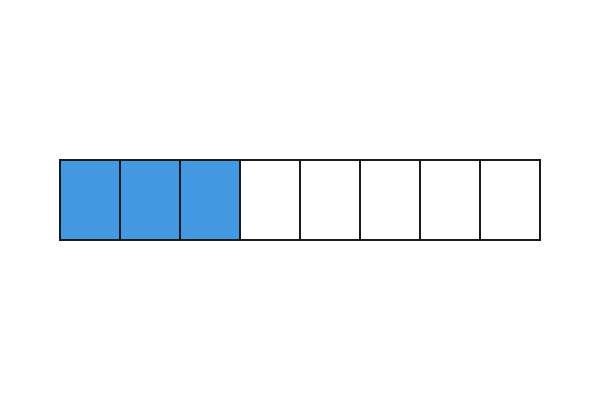
Tariq is painting this paper strip blue for a class banner. So far he has painted the blue parts. What fraction of the strip does he still need to paint?
- 5/3
- 3/8
- 5/8
Why this matters
Your child's journey with fractions begins here, and almost every fraction skill after it rests on seeing 3/4 as three pieces of size 1/4. That picture makes adding fractions in 4th grade feel like counting, since 1/4 + 2/4 is three fourths. It later supports decimals and measurement, and it shows up at home in recipes, pizza slices, and the half and quarter marks on a measuring cup.
Where kids can get stuck
- Calling any piece a fraction even when the pieces differ in size, such as saying 4 uneven pizza slices show fourths.
- Thinking 1/8 is bigger than 1/4 because 8 is bigger than 4.
- Counting shaded and unshaded parts instead of shaded and total parts, so 3 of 4 parts shaded becomes 3/1.
How you can help
- Cut a sandwich, tortilla, or pancake into equal pieces and name each piece as a fraction, then ask your child how many pieces make the whole thing.
- Fold a sheet of paper in half, then in half again, and ask your child to name each part and explain why the parts got smaller.
- Ask your child to share a granola bar fairly between 3 people and name each share as one third, talking about why the pieces must match.
Bobby's Math Club offers free practice that grows with your child.
Questions parents ask
Why is my child learning fractions with fractions like 1/4 first?
Fractions with 1 on top, called unit fractions, are the building blocks of all other fractions. Once your child understands that 1/4 is one of four equal parts, then 3/4 is three of those parts and 5/4 is five of them. Learning fractions this way helps your child see them as numbers that can be counted, not only as shaded shapes.
Why does my child think 1/8 is bigger than 1/4?
Because 8 is bigger than 4 in whole numbers, it seems natural that 1/8 should be bigger too. This is a very common early mix-up. Cutting real food helps: a pizza cut into 8 slices has smaller slices than one cut into 4. With experience, your child learns that more parts means smaller parts.
What fractions will my child learn in 3rd grade?
In 3rd grade, children usually work with fractions that have 2, 3, 4, 6, or 8 as the bottom number, such as halves, thirds, fourths, sixths, and eighths. These are easy to picture and fold. In 4th grade, fractions with 5, 10, 12, and 100 are added, and children begin adding and subtracting fractions.
Make learning math fun
Bobby's Math Club turns 3rd grade math practice into something fun to do together.
- Unlimited free practice
- Questions matched to your child’s level, a few minutes a day
- You see their progress and what to work on next

Written by Robert “Bobby” Barnett
Bobby is an award-winning math teacher, the author of Meet Every Learner’s Needs, and the father of two elementary-school math learners. He uses Bobby’s Math Club with his own kids a few times every week. Learn more or contact Bobby.
Ready to watch your child’s confidence grow?
Your 3rd grade child can start today with free, unlimited practice that grows with them.
Join the clubNote for teachers: This skill is covered by Common Core math standard 3.NF.A.1: “Understand a fraction 1/b as the quantity formed by 1 part when a whole is partitioned into b equal parts; understand a fraction a/b as the quantity formed by a parts of size 1/b.” Learn how Bobby's Math Club can help your students grow. (Common Core 3.NF.1)