
Knowing the times tables by heart
In 3rd grade, children learn to recall every product (the answer to a multiplication) of two one-digit numbers from memory, such as 7 x 8 = 56, in any order and without counting.

By Robert “Bobby” BarnettMath teacher, parent, and founder of Bobby’s Math Club
Try these with your child
These are real questions from our 3rd grade practice. Tap the speaker to hear one read aloud, or the light bulb for a hint, and talk about the answer together.
Question 1 of 3
How many small squares are in this array?
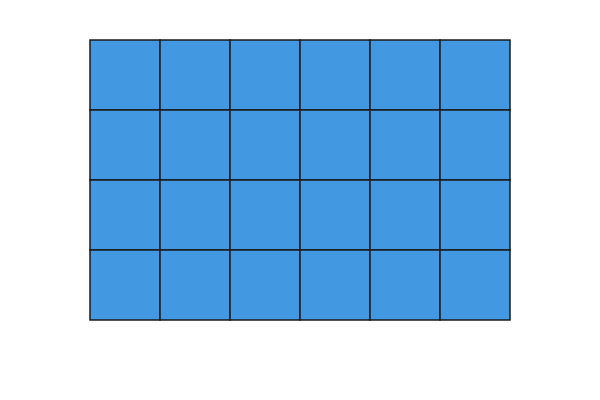
- 10
- 24
- 30
Why this matters
When the times tables come to your child without effort, their attention is free for the thinking in harder problems. In 4th and 5th grade, a problem like 47 x 6 holds several facts inside it, and counting out each one makes it easy to lose track of the bigger steps. Quick facts also smooth the way into fractions later on. And they come up at home: 4 packs of 6 yogurts, or 3 rows of 8 muffins.
Each fact your child learns here also opens up dividing within 100, which comes next.
Where kids can get stuck
- Confusing facts that sound or look alike, such as saying 6 x 8 is 42 or mixing up 7 x 8 and 7 x 6.
- Counting up from the start for every fact, so 7 x 9 means saying 9, 18, 27, 36, 45, 54, 63 each time.
- Knowing the facts in order when chanting a table, but not when one like 6 x 9 is asked on its own.
How you can help
- Play a quick fact game in the car, taking turns asking each other one multiplication fact at a time. Mix easy ones with hard ones, and keep it light.
- Pick a small set of tricky facts for a week, such as the 7s, and spot them in everyday life. Four weeks on the calendar is 4 x 7 = 28 days.
- Play a card game at the kitchen table. Set aside the face cards and the 10s, then each player flips two cards, and the first to say the product keeps them.
Want a little more? Try Bobby's Math Club for free practice that adapts to your child.
Questions parents ask
Why is my child learning tricks for the times tables instead of memorizing them?
Strategies give your child a way to find a fact they have forgotten, and the reasoning behind them helps facts stick. A child who knows that 9 x 6 is one group of 6 less than 10 x 6 can always get back to 54. Knowing every fact by heart is still the goal by the end of 3rd grade. The strategies are the bridge to it.
My child still counts on fingers for times tables. Should I worry?
Many 3rd graders count for some facts during the year, especially the 6s, 7s, 8s, and 9s. It helps to notice which facts your child already knows instantly and add a few new ones at a time. Short practice works better than long sessions. I recommend 5 minutes a day, and it doesn’t have to be every single day. If counting is still common late in the year, mention it to the teacher.
Which multiplication facts are the hardest to learn?
Facts with 6, 7, and 8 tend to be the hardest, such as 6 x 7, 7 x 8, and 6 x 8, because there are fewer patterns to lean on. The good news is that once your child knows the 0s, 1s, 2s, and 5s, and sees that 3 x 8 and 8 x 3 are the same fact, far fewer facts are left than the full chart suggests.
Make learning math fun
Bobby's Math Club turns 3rd grade math practice into something fun to do together.
- Unlimited free practice
- Practice that starts where your child is and grows with them
- You see their progress and what to work on next

Written by Robert “Bobby” Barnett
Bobby is an award-winning math teacher, the author of Meet Every Learner’s Needs, and the father of two elementary-school math learners. He uses Bobby’s Math Club with his own kids a few times every week. Learn more or contact Bobby.
Ready to watch your child’s confidence grow?
Your 3rd grade child can start today with free, unlimited practice that grows with them.
Join the clubNote for teachers: This skill is covered by Common Core math standard 3.OA.C.7: “Fluently multiply and divide within 100, using strategies such as the relationship between multiplication and division (e.g., knowing that 8 x 5 = 40 one knows 40 ÷ 5 = 8) or properties of operations. By the end of Grade 3, know from memory all products of two one-digit numbers.” Learn how Bobby's Math Club can help your students grow. (Common Core 3.OA.7)