
Finding area by counting squares
In 3rd grade, children learn to find the area of a shape by counting unit squares, such as square centimeters, square inches, square feet, square meters, or squares they make up themselves.

By Robert “Bobby” BarnettMath teacher, parent, and founder of Bobby’s Math Club
Try these with your child
These are real questions from our 3rd grade practice. Tap the speaker to hear one read aloud, or the light bulb for a hint, and talk about the answer together.
Question 1 of 3
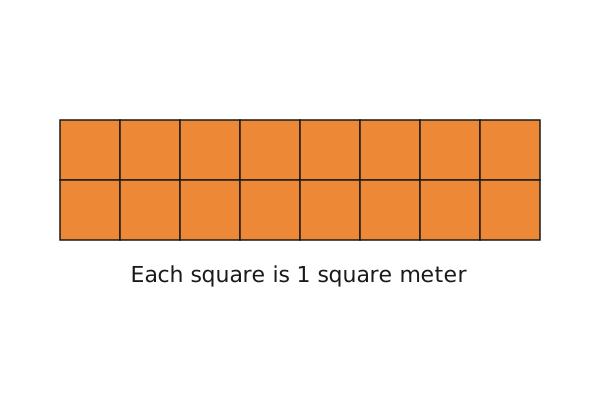
The picture shows the floor of a school hallway. Each square is 1 square meter. What is the area of the floor?
- 16 meters
- 16 square meters
- 20 square meters
Why this matters
Counting squares lets your child see exactly what an area number means, long before any formula appears. While counting, many children notice they can count one row and multiply, which leads straight to finding a rectangle's area. Working with square inches, square feet, and square meters also builds a sense of size that helps later with floor plans, gardens, and the area work of 4th and 5th grade.
Where kids can get stuck
- Counting some squares twice or skipping some in a large shape, so the area is off by a few.
- Writing inches instead of square inches, not yet seeing that area is counted in squares, not lengths.
- Counting the grid lines instead of the squares between them, so a shape 4 squares wide becomes 5.
How you can help
- Count the square tiles on a bathroom or kitchen floor to find the area of a section, and help your child count by rows to keep track.
- Use a waffle, a sheet of crackers, or a chocolate bar with squares and ask your child how many squares cover the whole thing.
- Ask your child to measure the area of a book cover using sticky notes or playing cards, then compare it with a sibling's measurement using different objects.
Bobby's Math Club offers free practice that grows with your child.
Questions parents ask
Why is my child counting squares instead of using a formula?
Counting squares shows exactly what area is measuring. As your child counts, many begin to notice that a rectangle with 4 rows of 6 squares has 24 squares, which leads naturally to multiplying. A formula learned this way makes sense. A formula learned without it is easy to misuse, such as multiplying the wrong measurements.
What are improvised units?
Improvised units are everyday objects used as measuring squares, such as sticky notes, square crackers, or tiles. Measuring a table with sticky notes might give an area of 30 sticky notes. Using these first helps your child understand what measuring area means, and seeing different answers with different objects shows why everyone uses standard square units.
How do I know which square unit to use?
Choose a unit that fits the size of the object. Square centimeters or square inches work for small things like a notebook. Square feet fit a rug or a bedroom, and square meters fit a classroom or a yard. Asking your child which unit would make sense for different objects is a quick way to practice this.
Make learning math fun
Bobby's Math Club turns 3rd grade math practice into something fun to do together.
- Unlimited free practice
- Practice that starts where your child is and grows with them
- You see their progress and what to work on next

Written by Robert “Bobby” Barnett
Bobby is an award-winning math teacher, the author of Meet Every Learner’s Needs, and the father of two elementary-school math learners. He uses Bobby’s Math Club with his own kids a few times every week. Learn more or contact Bobby.
Ready to watch your child’s confidence grow?
Your 3rd grade child can start today with free, unlimited practice that grows with them.
Join the clubNote for teachers: This skill is covered by Common Core math standard 3.MD.C.6: “Measure areas by counting unit squares (square cm, square m, square in, square ft, and improvised units).” Learn how Bobby's Math Club can help your students grow. (Common Core 3.MD.6)