
Sorting four-sided shapes into families
In 3rd grade, children learn to sort shapes into bigger groups by shared features, so squares, rectangles, and rhombuses are all quadrilaterals, or four-sided shapes; and to draw quadrilaterals that fit none of those.

By Robert “Bobby” BarnettMath teacher, parent, and founder of Bobby’s Math Club
Try these with your child
These are real questions from our 3rd grade practice. Tap the speaker to hear one read aloud, or the light bulb for a hint, and talk about the answer together.
Question 1 of 3
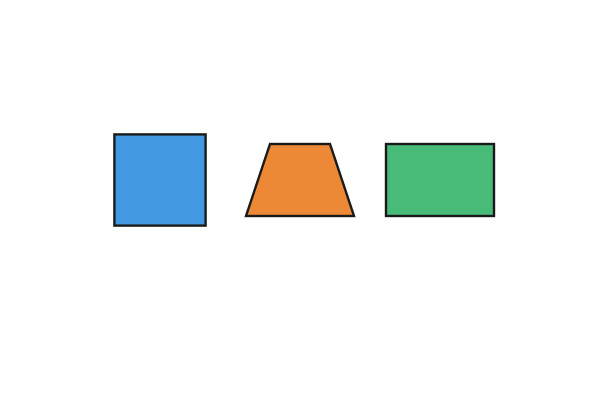
Look at the shapes. They are all quadrilaterals. How many of them have 4 square corners?
- 2
- 3
- 1
Why this matters
Learning to sort shapes by their features teaches your child to trust a definition over a first glance, so a square tilted onto its corner is still a square. That habit carries into 4th grade, where shapes are grouped by parallel lines and angles, and into 5th grade, where they are arranged into families. Later geometry, including showing that something is always true, builds on this same careful thinking.
Where kids can get stuck
- Saying a square is not a rectangle because it does not look long and thin, though it has four square corners.
- Thinking a turned shape becomes a different shape, calling a tilted square a diamond instead of a square.
- Counting only rectangles and squares as quadrilaterals, leaving out shapes with four uneven straight sides.
How you can help
- Look for four-sided shapes on a walk, such as windows, signs, and doors, and ask your child which group each belongs to and why.
- Draw four-sided shapes together that are not squares, rectangles, or rhombuses, such as a kite or a lopsided shape with no equal sides. Ask your child to check that each one has four straight sides, so it is a quadrilateral too.
- Make shapes with straws or toothpicks and ask your child to change a square into a rhombus by pushing its corners, then discuss what stayed the same.
Bobby's Math Club offers free practice that grows with your child.
Questions parents ask
Why is my child learning that a square is a rectangle?
In math, a rectangle is any four-sided shape with four square corners. A square has four square corners, so it fits the definition, even though it also has equal sides. Learning this teaches your child to decide by the rules of a shape, not by how it looks. That kind of thinking is used throughout math.
What is a rhombus?
A rhombus is a four-sided shape with all four sides the same length. It often looks like a diamond or a tilted square. A square is a special rhombus that also has square corners. Your child does not need formal definitions, but they should know that a rhombus has four equal sides.
What does it mean for shapes to share attributes?
Attributes are features such as the number of sides, side lengths, and corner types. Shapes that look different can share attributes. A rectangle and a rhombus both have four sides, so both belong to the larger group called quadrilaterals. Noticing these shared features helps your child organize shapes into groups.
Make learning math fun
Bobby's Math Club turns 3rd grade math practice into something fun to do together.
- Free, unlimited practice for every child in your family
- Questions matched to your child’s level, a few minutes a day
- Hints when they are stuck, and a celebration when it clicks

Written by Robert “Bobby” Barnett
Bobby is an award-winning math teacher, the author of Meet Every Learner’s Needs, and the father of two elementary-school math learners. He uses Bobby’s Math Club with his own kids a few times every week. Learn more or contact Bobby.
Ready to watch your child’s confidence grow?
Your 3rd grade child can start today with free, unlimited practice that grows with them.
Join the clubNote for teachers: This skill is covered by Common Core math standard 3.G.A.1: “Understand that shapes in different categories (e.g., rhombuses, rectangles, and others) may share attributes (e.g., having four sides), and that the shared attributes can define a larger category (e.g., quadrilaterals). Recognize rhombuses, rectangles, and squares as examples of quadrilaterals, and draw examples of quadrilaterals that do not belong to any of these subcategories.” Learn how Bobby's Math Club can help your students grow. (Common Core 3.G.1)