
Fractions on a number line
In 3rd grade, children learn that fractions are numbers with their own places on a number line, so 3/4 sits three fourths of the way from 0 to 1.

By Robert “Bobby” BarnettMath teacher, parent, and founder of Bobby’s Math Club
Try these with your child
These are real questions from our 3rd grade practice. Tap the speaker to hear one read aloud, or the light bulb for a hint, and talk about the answer together.
Question 1 of 3
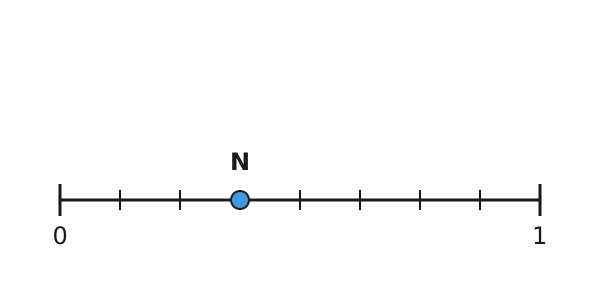
The number line from 0 to 1 is cut into equal parts. Which fraction is at point N?
- 3/8
- 5/8
- 4/8
Why this matters
On a number line, your child gets to see that 3/4 is an amount with its own place among other numbers, not only a shaded picture. That makes it easier to compare fractions, to notice that 5/4 is more than 1, and later to place decimals like 0.75 in the very same spot. Rulers and measuring tapes are number lines too, so this idea gets everyday use.
Where kids can get stuck
- Counting the tick marks instead of the spaces, so a line from 0 to 1 in fourths, with 5 marks, gets labeled in fifths.
- Drawing unequal spaces on the number line, so the fractions land in the wrong places.
- Thinking fractions only go between 0 and 1, and leaving numbers like 4/4 or 6/4 off the line.
How you can help
- Lay a strip of tape on the floor from 0 to 1, fold or mark it in half and in fourths, and have your child hop to 1/4, 2/4, and 3/4.
- Talk about distance on a walk, such as saying you are halfway to the corner, and ask your child where one fourth of the way would be.
- Use a measuring tape or ruler to find 1/2 and 1/4 of an inch, showing that fractions are points along the length.
Bobby's Math Club offers free practice that grows with your child.
Questions parents ask
Why is my child putting fractions on a number line?
The number line shows that a fraction is a number with a size and a place, like 3 or 7. That idea is easy to miss when fractions are always shown as pieces of pizza. Seeing 1/2 halfway between 0 and 1 helps your child compare fractions, understand fractions bigger than 1, and connect fractions to measuring.
Why does my child keep putting fractions in the wrong spot?
The most common reason is counting the tick marks instead of the spaces between them. On a line from 0 to 1 split into 4 equal spaces, there are 5 marks, including 0 and 1. Remind your child that each fourth is a length, a jump from one mark to the next, and the fraction names where that jump ends.
Can a fraction be bigger than 1?
Yes. If the top number is bigger than the bottom number, the fraction is more than 1 whole. For example, 5/4 is five fourths, which is one whole and one fourth more. On a number line, it sits one fourth past 1. Many 3rd graders find this surprising, and the number line helps it make sense.
Make learning math fun
Bobby's Math Club turns 3rd grade math practice into something fun to do together.
- Unlimited practice, completely free
- A few minutes a day, at just the right level
- Hints when they are stuck, and a celebration when it clicks

Written by Robert “Bobby” Barnett
Bobby is an award-winning math teacher, the author of Meet Every Learner’s Needs, and the father of two elementary-school math learners. He uses Bobby’s Math Club with his own kids a few times every week. Learn more or contact Bobby.
Ready to watch your child’s confidence grow?
Your 3rd grade child can start today with free, unlimited practice that grows with them.
Join the clubNote for teachers: This skill is covered by Common Core math standard 3.NF.A.2: “Understand a fraction as a number on the number line; represent fractions on a number line diagram. a. Represent a fraction 1/b on a number line diagram by defining the interval from 0 to 1 as the whole and partitioning it into b equal parts. Recognize that each part has size 1/b and that the endpoint of the part based at 0 locates the number 1/b on the number line. b. Represent a fraction a/b on a number line diagram by marking off a lengths 1/b from 0. Recognize that the resulting interval has size a/b and that its endpoint locates the number a/b on the number line.” Learn how Bobby's Math Club can help your students grow. (Common Core 3.NF.2)