
i-Ready Classroom Mathematics Kindergarten, Unit 2: Numbers to 10 and Comparing
In this unit, counting reaches 10 and comparing begins. Your child counts and writes the numbers 6 to 10, decides which group has more, fewer, or the same, and tells which of two numbers is greater. Building on counting to 5 from the first unit, this gives your child a solid feel for amounts, ready for the next unit, where small numbers are added and subtracted.

By Robert “Bobby” BarnettMath teacher, parent, and founder of Bobby’s Math Club
What is my child learning in Unit 2?
- Writing the numerals 6 to 10 and using them to record the number of objects in a group. Learn more: Writing numbers from 0 to 20
- Seeing that each next number is one more, so a group of 9 with one added becomes 10. Learn more: How counting tells you how many
- Counting up to 10 objects in rows, circles, or scattered groups, and counting out a number like 8. Learn more: Counting groups of up to 20 things
- Comparing two groups of up to 10 by matching or counting, and saying which has more, fewer, or the same. Learn more: Which group has more, fewer, or the same
- Comparing two written numbers between 1 and 10 and saying which is greater and which is less. Learn more: Comparing numbers from 1 to 10
Sample questions to try together
These are real questions from our practice. Tap the speaker to hear one read aloud, or the light bulb for a hint, and talk about the answer together.
Question 1 of 3
How many apples do you see?
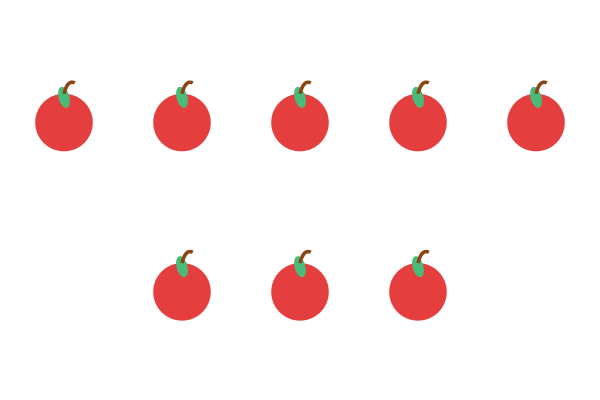
- 9
- 7
- 8
How you can help
- Ask your child to count out 8 cups and 6 plates for a pretend party, then say whether there are more cups or more plates.
- Each hold up some fingers, up to 10, and let your child say whose number is greater and whose is less, then switch.
- Arrange 9 socks in a circle on the floor and let your child count them, marking the first sock so the count stops in the right place.
Where kids can get stuck
- Judging a long, spread-out row of 6 as more than a tight row of 8.
- Pointing to the greater number when asked which is less.
- Continuing round a circle of objects, without marking where they started counting.
Practice makes perfect
Bobby's Math Club has practice problems that adapt to your child’s level, each with a detailed explanation and an easy-to-follow video, so your child can build confidence in these skills one step at a time.
Words your child will hear
- numeral
- The written symbol for a number, like 7.
- one more
- The next number when counting; one more than 6 is 7.
- compare
- To look at two things or numbers and tell how they are different.
- more
- Having a larger number of things than another group.
- fewer
- Having a smaller number of things than another group.
- greater than
- More in number; 8 is greater than 5.
- less than
- Fewer in number; 3 is less than 6.
- same
- Having exactly as many as another group.
Ready to build your child’s confidence with counting and comparing to 10?
In Bobby's Math Club, your child practices these skills at just the right level, with a hint when they need one, a clear explanation after every question, and kid-friendly videos. Unlimited practice is free.
Join the club
Written by Robert “Bobby” Barnett
Bobby is an award-winning math teacher, the author of Meet Every Learner’s Needs, and the father of two elementary-school math learners. He uses Bobby’s Math Club with his own kids a few times every week. Learn more or contact Bobby.
Which math standards does i-Ready Classroom Mathematics Kindergarten Unit 2 cover?
i-Ready Classroom Mathematics Kindergarten Unit 2 covers these math standards. Each one links to what it means, sample questions, and teaching strategies.
For teachers: Unit names and order vary between editions and districts, so your school’s own materials have the exact sequence. Learn how Bobby's Math Club can help your students grow.