
Writing numbers from 0 to 20
In kindergarten, children learn to write the numbers 0 to 20 and to use them to record how many objects are in a group, including 0 for an empty group.

By Robert “Bobby” BarnettMath teacher, parent, and founder of Bobby’s Math Club
Try these with your child
These are real questions from our kindergarten practice. Tap the speaker to hear one read aloud, or the light bulb for a hint, and talk about the answer together.
Question 1 of 3
How many apples do you see?
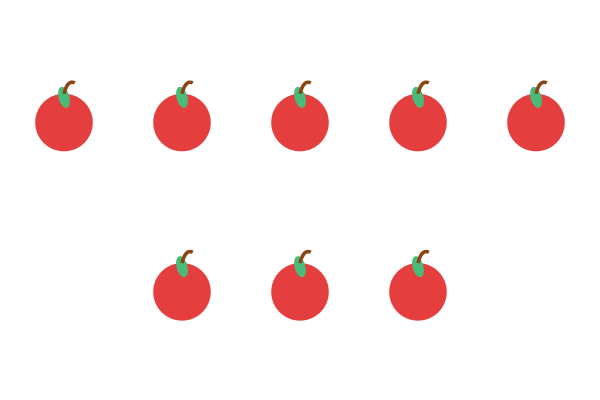
- 9
- 7
- 8
Why this matters
Writing numbers lets your child keep a record of what they count, so amounts can be compared, shared, and used later. Writing the teens correctly, with the 1 first in 14, also prepares them for 1st grade, where 14 means one ten and four ones. By the end of 1st grade your child will read and write numbers up to 120, and every written equation after that relies on this skill.
Where kids can get stuck
- Writing fourteen as 41, putting the 4 first because it is the sound they hear first.
- Reversing some numerals, such as 3 or 7, which is common in kindergarten and does not mean the amount is misunderstood.
- Counting a group of 12 correctly but writing 2 or 10, not yet knowing how to write a two-digit number.
How you can help
- Count the items as you unpack groceries, such as 12 eggs or 15 crackers, and let your child write the number on a sticky note.
- Keep a family tally of something for a week, such as hugs or books read, and let your child write the total each day.
- Write the numbers 0 to 20 in chalk on the sidewalk and let your child hop along them, saying each number as they land on it.
If it’s helpful, you can watch the kid-friendly video below, or sign up for free, adaptive practice in Bobby's Math Club.
Kid-friendly explanation
Questions parents ask
Why is my child learning to write numbers by recording amounts?
Writing a number only means something when it stands for a real amount. Recording how many objects are in a group teaches your child that a numeral is a record of a count. That connection between symbol and quantity is what makes reading and writing numbers useful, rather than a handwriting exercise.
My child writes 13 as 31. Why does that happen?
When we say "thirteen," we hear the three part first, so many children write the 3 first. The teen numbers are the only ones where spoken order and written order are reversed. Point out that every teen number starts with 1, which stands for ten. Saying "ten and three" as you write 13 helps the order make sense.
How will writing numbers to 20 help in 1st grade?
Writing the teen numbers introduces the pattern of tens and ones. Every number from 11 to 19 starts with a 1 that means one group of ten. In 1st grade, children build on this to read and write numbers up to 120 and to understand what each digit in a two-digit number means.
Make learning math fun
Bobby's Math Club turns kindergarten math practice into something fun to do together.
- Unlimited free practice
- Questions matched to your child’s level, a few minutes a day
- You see their progress and what to work on next

Written by Robert “Bobby” Barnett
Bobby is an award-winning math teacher, the author of Meet Every Learner’s Needs, and the father of two elementary-school math learners. He uses Bobby’s Math Club with his own kids a few times every week. Learn more or contact Bobby.
Ready to watch your child’s confidence grow?
Your kindergarten child can start today with free, unlimited practice that grows with them.
Join the clubNote for teachers: This skill is covered by Common Core math standard K.CC.A.3: “Write numbers from 0 to 20. Represent a number of objects with a written numeral 0-20 (with 0 representing a count of no objects).” Learn how Bobby's Math Club can help your students grow. (Common Core K.CC.3)