
Counting groups of up to 20 things
In kindergarten, children learn to count up to 20 objects in a line, grid, or circle; to count up to 10 scattered objects; and to count out any number from 1 to 20.

By Robert “Bobby” BarnettMath teacher, parent, and founder of Bobby’s Math Club
Try these with your child
These are real questions from our kindergarten practice. Tap the speaker to hear one read aloud, or the light bulb for a hint, and talk about the answer together.
Question 1 of 3
How many apples do you see?
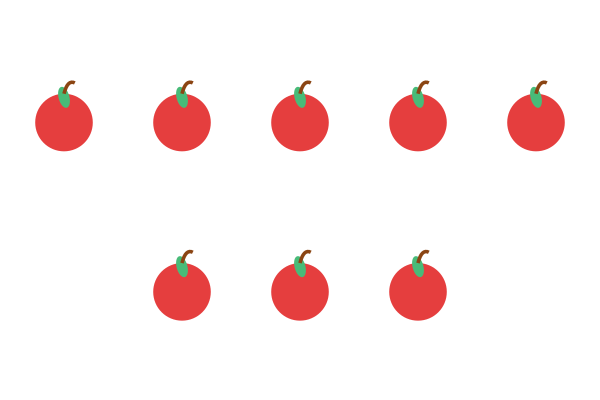
- 9
- 7
- 8
Why this matters
Your child will count groups of things every day, from coins in a jar to plates for every guest. In math, accurate counting is the base for adding and comparing groups in kindergarten, and for 1st grade, where children count bigger collections by bundling them into tens. Keeping track of what has been counted also builds the habit that makes later problem solving careful rather than rushed.
Where kids can get stuck
- Jumping between the two rows of an egg carton, losing track of which eggs are done and ending with 10 or 14.
- Counting out 17 blocks when asked, then adding more because they are not watching for the moment to stop.
- Counting 9 scattered cars correctly, but recounting some when there are 10, because the bigger pile is harder to track.
How you can help
- Ask your child to count out 18 crackers for a family snack, then count them again together by placing them in rows of five to check.
- Count the eggs or muffin cups in a carton or tin, showing how counting row by row keeps track of which ones are done.
- Scatter 10 coins on the table and have your child slide each one into a cup as they count it, so none are missed or counted twice.
The kid-friendly video below explains it in a few minutes, and Bobby's Math Club offers free practice that grows with your child.
Kid-friendly explanation
Questions parents ask
Why does my child practice counting objects in a circle or scattered?
Real collections rarely come in neat lines. Counting a circle teaches your child to mark where they started, and counting a scattered pile teaches them to keep track of what is done. These strategies make counting reliable when groups get larger. They are the same habits your child will use when counting money or objects in later grades.
My child can count to 20 out loud but not count 20 objects. Why?
Saying numbers and counting objects use different skills. Counting objects needs careful matching of one number to one object, plus keeping track of which ones are done. Larger groups make both harder. Encourage your child to move objects as they count or to line them up first. Those habits make counting large groups easier.
What comes after counting to 20 objects?
In 1st grade, children count larger collections, often by putting objects into groups of ten and counting the tens and leftover ones. That approach builds on the careful counting your child does now and leads into understanding place value. Counting by tens is quicker and makes mistakes easier to catch.
Make learning math fun
Bobby's Math Club turns kindergarten math practice into something fun to do together.
- Free, unlimited practice for every child in your family
- Questions matched to your child’s level, a few minutes a day
- You see their progress and what to work on next

Written by Robert “Bobby” Barnett
Bobby is an award-winning math teacher, the author of Meet Every Learner’s Needs, and the father of two elementary-school math learners. He uses Bobby’s Math Club with his own kids a few times every week. Learn more or contact Bobby.
Ready to watch your child’s confidence grow?
Your kindergarten child can start today with free, unlimited practice that grows with them.
Join the clubNote for teachers: This skill is covered by Common Core math standard K.CC.B.5: “Count to answer "how many?" questions about as many as 20 things arranged in a line, a rectangular array, or a circle, or as many as 10 things in a scattered configuration; given a number from 1-20, count out that many objects.” Learn how Bobby's Math Club can help your students grow. (Common Core K.CC.5)