
Telling flat shapes from solid shapes
In kindergarten, children learn to tell flat shapes, like a square drawn on paper, from solid shapes, like a block or a ball; and to call them two-dimensional or three-dimensional.

By Robert “Bobby” BarnettMath teacher, parent, and founder of Bobby’s Math Club
Try these with your child
These are real questions from our kindergarten practice. Tap the speaker to hear one read aloud, or the light bulb for a hint, and talk about the answer together.
Question 1 of 3
Look at this shape. Is it a flat shape or a solid shape?
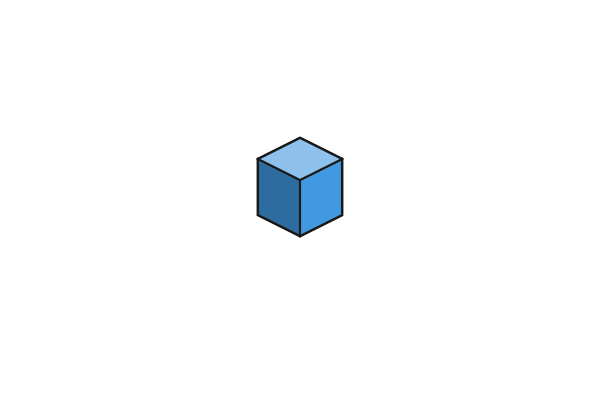
- A solid shape
- A round shape
- A flat shape
Why this matters
A ball is a sphere, not a circle, and telling the two apart helps your child describe the world accurately. It prepares them to see that solid shapes are made of flat faces, like the six squares on a cube. That idea leads to building and describing both kinds of shape in 1st and 2nd grade, and much later to finding the volume of a box in 5th grade.
Where kids can get stuck
- Calling a ball a circle or a block a square, using a flat name because that is how it looks from one side.
- Treating a paper plate or a coin as a flat shape, not seeing that it is a very thin solid.
- Sorting shapes by color or size instead of by whether they are flat or solid.
How you can help
- Gather a ball, a cereal box, a can, and a paper cutout of a circle, and ask your child to sort them into flat and solid, explaining each choice.
- Trace around a block on paper and compare the drawing with the block, talking about how the drawing is flat and the block is solid.
- Go on a walk and point out solid shapes, such as a cylinder in a trash can or a cone on the road, and flat shapes on signs.
Want a little more? Watch the kid-friendly video below together, or try Bobby's Math Club for free practice that adapts to your child.
Kid-friendly explanation
Questions parents ask
Why does my child need to know the difference between flat and solid shapes?
Children often use flat shape names for solid objects, such as calling a ball a circle. Learning the difference helps your child describe shapes precisely. It also lays the groundwork for understanding how solid shapes are made of flat faces, which becomes important in later geometry, such as finding the surface of a box.
Do kindergartners need to say two-dimensional and three-dimensional?
Kindergartners often use the words flat and solid, and many hear the terms two-dimensional and three-dimensional from their teachers. Understanding the idea matters more than the vocabulary. If your child can sort shapes into flat and solid and explain why, they understand the skill.
Is a coin a flat shape or a solid shape?
Strictly, a coin is a very thin solid, because it can be picked up and has some thickness. Its face is shaped like a circle. Thin objects like coins and paper plates can confuse children, and that is fine. The clearest examples for kindergarten are drawings for flat shapes and blocks, balls, and boxes for solid shapes.
Make learning math fun
Bobby's Math Club turns kindergarten math practice into something fun to do together.
- Unlimited practice, completely free
- Practice that starts where your child is and grows with them
- Hints when they are stuck, and a celebration when it clicks

Written by Robert “Bobby” Barnett
Bobby is an award-winning math teacher, the author of Meet Every Learner’s Needs, and the father of two elementary-school math learners. He uses Bobby’s Math Club with his own kids a few times every week. Learn more or contact Bobby.
Ready to watch your child’s confidence grow?
Your kindergarten child can start today with free, unlimited practice that grows with them.
Join the clubNote for teachers: This skill is covered by Common Core math standard K.G.A.3: “Identify shapes as two-dimensional (lying in a plane, "flat") or three-dimensional ("solid").” Learn how Bobby's Math Club can help your students grow. (Common Core K.G.3)