
Sorting things into groups and counting them
In kindergarten, children learn to sort objects into given groups, to count how many are in each group, and to put the groups in order from most to fewest.

By Robert “Bobby” BarnettMath teacher, parent, and founder of Bobby’s Math Club
Try these with your child
These are real questions from our kindergarten practice. Tap the speaker to hear one read aloud, or the light bulb for a hint, and talk about the answer together.
Question 1 of 3
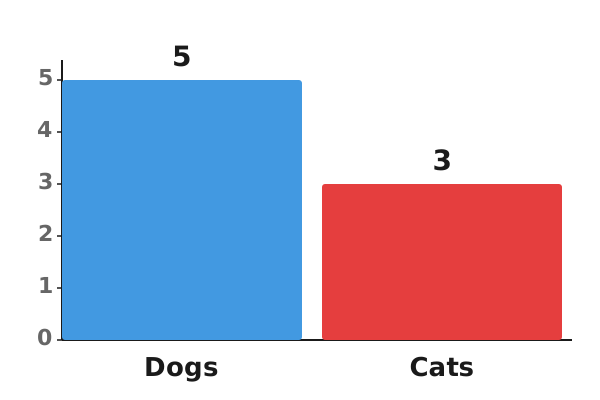
Look at the chart. How many dogs are there?
- 5
- 8
- 3
Why this matters
Sorting toys or snacks and counting each pile is how your child begins working with data. It leads to 1st grade, where they organize information into simple charts and say how many more are in one group, and to 2nd grade, where they make picture graphs and bar graphs. Reading graphs carefully is a skill they will use later in science, in the news, and in many everyday decisions.
Where kids can get stuck
- Ordering the groups by the space they take up, so 5 large blocks seem like more than 8 small ones.
- Putting the groups in order from fewest to most when asked for most to fewest.
- Sorting by their own rule, such as grouping toy animals by size when asked to sort by whether they fly.
How you can help
- Sort the clean laundry into shirts, socks, and pants; count each pile; and ask your child which pile has the most and which has the fewest.
- Dump out a handful of mixed snacks, sort them by type, count each group, and line the groups up from most to fewest before eating.
- Sort a few toy vehicles into cars, trucks, and other kinds, then count each group and let your child put them in order by how many there are.
The kid-friendly video below explains it in a few minutes, and Bobby's Math Club offers free practice that grows with your child.
Kid-friendly explanation
Questions parents ask
Why is my child learning to sort and order groups by count?
Sorting, counting, and ordering groups are the first steps in working with data. Sorting organizes things, counting gives each group a number, and ordering lets your child compare the groups. That process answers questions such as "which do we have most of?" It prepares your child for reading and making simple graphs in 1st grade.
How is this different from sorting in Pre-K?
In Pre-K, children sort objects and count each group. In kindergarten, they also put the groups in order by how many are in each, from most to fewest or fewest to most. This extra step asks your child to compare several numbers at once, which builds on their skill in comparing numbers.
What should my child do if two groups have the same number?
If two groups have the same count, they are equal, and your child can say so. They might place those groups side by side in the order. Noticing a tie is part of the skill, because it shows your child is comparing the counts rather than guessing from how the piles look.
Make learning math fun
Bobby's Math Club turns kindergarten math practice into something fun to do together.
- Unlimited practice, completely free
- Questions matched to your child’s level, a few minutes a day
- Hints when they are stuck, and a celebration when it clicks

Written by Robert “Bobby” Barnett
Bobby is an award-winning math teacher, the author of Meet Every Learner’s Needs, and the father of two elementary-school math learners. He uses Bobby’s Math Club with his own kids a few times every week. Learn more or contact Bobby.
Ready to watch your child’s confidence grow?
Your kindergarten child can start today with free, unlimited practice that grows with them.
Join the clubNote for teachers: This skill is covered by Common Core math standard K.MD.B.3: “Classify objects into given categories; count the numbers of objects in each category and sort the categories by count.” Learn how Bobby's Math Club can help your students grow. (Common Core K.MD.3)