
Putting shapes together to make new shapes
In kindergarten, children learn to put simple shapes together to make larger shapes, such as joining two triangles along a full side to make a rectangle.

By Robert “Bobby” BarnettMath teacher, parent, and founder of Bobby’s Math Club
Try these with your child
These are real questions from our kindergarten practice. Tap the speaker to hear one read aloud, or the light bulb for a hint, and talk about the answer together.
Question 1 of 3
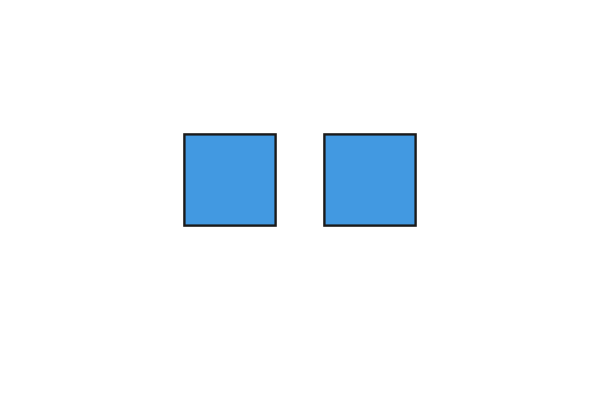
If you put these two blue squares together side-by-side, what larger shape can they make?
- Triangle
- Circle
- Rectangle
Why this matters
Every time your child fits two triangles into a rectangle, they are building spatial reasoning: the ability to picture shapes and move them in their mind. It also shows that one shape can be made of others, which leads to splitting shapes into halves and fourths in 1st grade, to fractions in 3rd grade, and to finding area by breaking a shape into parts. The same skill helps with puzzles, building toys, and reading maps.
Where kids can get stuck
- Joining two triangles corner to corner instead of side to side, leaving a gap instead of a rectangle.
- Letting sides touch only partly, so edges overlap or leave a step and the new shape comes out wrong.
- Trying one position, deciding the pieces do not fit, and giving up without turning or flipping them.
How you can help
- Cut a square sandwich or a slice of bread corner to corner into two triangles, then challenge your child to put the triangles back into a square.
- Fold a paper napkin into triangles and rectangles, then cut along the folds and let your child rebuild the napkin from the pieces.
- Use square crackers to build bigger shapes on a plate, such as a long rectangle from three crackers or a larger square from four.
If it’s helpful, you can watch the kid-friendly video below, or sign up for free, adaptive practice in Bobby's Math Club.
Kid-friendly explanation
Questions parents ask
Why is my child learning to put shapes together?
Combining shapes builds spatial reasoning, the ability to picture shapes and move them in your mind. It shows that larger shapes can be made of smaller ones, an idea that supports understanding area and fractions later. It also encourages problem solving, since your child has to turn and test pieces to make them fit.
What does "full sides touching" mean?
It means the edges of the two shapes line up completely, from corner to corner, with no gaps and no overlaps. For example, two triangles make a rectangle only when their long sides match up exactly. This careful fitting helps your child see how the parts form a new, whole shape.
My child gets frustrated when shapes do not fit. How can I help?
Show your child that turning or flipping a piece can change how it fits. Try saying, "What happens if you turn it around?" and let them experiment. Starting with simple combinations, like two squares making a rectangle, builds confidence before harder puzzles. Patience and play help more than giving the answer.
Make learning math fun
Bobby's Math Club turns kindergarten math practice into something fun to do together.
- Unlimited practice, completely free
- Questions matched to your child’s level, a few minutes a day
- Hints when they are stuck, and a celebration when it clicks

Written by Robert “Bobby” Barnett
Bobby is an award-winning math teacher, the author of Meet Every Learner’s Needs, and the father of two elementary-school math learners. He uses Bobby’s Math Club with his own kids a few times every week. Learn more or contact Bobby.
Ready to watch your child’s confidence grow?
Your kindergarten child can start today with free, unlimited practice that grows with them.
Join the clubNote for teachers: This skill is covered by Common Core math standard K.G.B.6: “Compose simple shapes to form larger shapes. For example, "Can you join these two triangles with full sides touching to make a rectangle?"” Learn how Bobby's Math Club can help your students grow. (Common Core K.G.6)