
Naming shapes turned any which way
In kindergarten, children learn to name shapes correctly however they are turned and whatever their size, including a triangle pointing down and a tilted square.

By Robert “Bobby” BarnettMath teacher, parent, and founder of Bobby’s Math Club
Try these with your child
These are real questions from our kindergarten practice. Tap the speaker to hear one read aloud, or the light bulb for a hint, and talk about the answer together.
Question 1 of 3
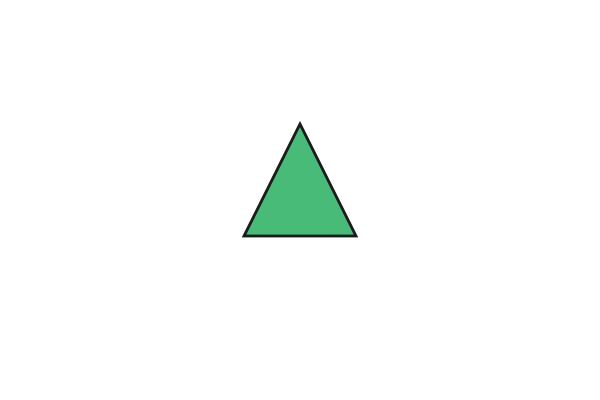
What shape do you see?
- Circle
- Square
- Triangle
Why this matters
Recognizing a shape however it is turned teaches your child something important: a shape's name comes from its features, not its position. A tilted square is still a square, and that idea leads to 1st grade's work on which features define a shape. In 2nd and 3rd grade, children sort squares, rectangles, and other four-sided shapes by their sides and corners, which is hard if a turned shape looks like something new.
Where kids can get stuck
- Calling a square tilted on its corner a diamond, and insisting it is not a square.
- Rejecting a triangle that points down, or a long, thin one, because it does not look like the usual triangle.
- Naming an upright rectangle but calling one lying on its side a different shape, because it no longer looks like a door.
How you can help
- Cut a square from paper and slowly turn it, asking your child at each turn whether it is still a square and how they can tell.
- Look for triangles pointing in different directions, such as yield signs, slices of pizza, and roof shapes, and talk about why they are all triangles.
- Make shapes with a rubber band on your fingers or a loop of string, then tilt and stretch them, asking your child to name each one.
The kid-friendly video below is a nice one to watch together. For more, Bobby's Math Club has free practice at your child’s level.
Kid-friendly explanation
Questions parents ask
Why does my child need to know a tilted square is still a square?
A shape is defined by its features, such as four equal sides and four square corners, not by which way it is facing. When your child sees that turning a square does not change it, they are starting to think about shapes by their properties. That is how geometry works in later grades, so this is an important first step.
My child calls a tilted square a diamond. Is that wrong?
Diamond is an everyday word, not a math name for a shape, and it causes a lot of confusion. A tilted square is still a square. You can say, "It looks like a diamond, and in math we call it a square, because it still has four equal sides." Turning a paper square back and forth helps your child see this.
Which shapes does a kindergartner need to recognize?
Kindergartners work with flat shapes such as squares, circles, triangles, rectangles, and hexagons; and solid shapes such as cubes, cones, cylinders, and spheres. The goal is to recognize each shape in many sizes and positions, not only in its most familiar form.
Make learning math fun
Bobby's Math Club turns kindergarten math practice into something fun to do together.
- Unlimited practice, completely free
- Questions matched to your child’s level, a few minutes a day
- Hints when they are stuck, and a celebration when it clicks

Written by Robert “Bobby” Barnett
Bobby is an award-winning math teacher, the author of Meet Every Learner’s Needs, and the father of two elementary-school math learners. He uses Bobby’s Math Club with his own kids a few times every week. Learn more or contact Bobby.
Ready to watch your child’s confidence grow?
Your kindergarten child can start today with free, unlimited practice that grows with them.
Join the clubNote for teachers: This skill is covered by Common Core math standard K.G.A.2: “Correctly name shapes regardless of their orientations or overall size.” Learn how Bobby's Math Club can help your students grow. (Common Core K.G.2)