
Comparing which is longer, taller, or heavier
In kindergarten, children learn to compare two objects directly to see which is longer, taller, or heavier, or which holds more; and to describe the difference in words.

By Robert “Bobby” BarnettMath teacher, parent, and founder of Bobby’s Math Club
Try these with your child
These are real questions from our kindergarten practice. Tap the speaker to hear one read aloud, or the light bulb for a hint, and talk about the answer together.
Question 1 of 3
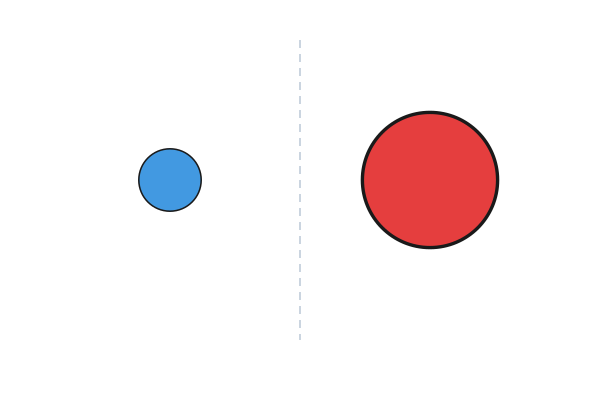
Look at the red circle and the blue circle. Which circle is bigger?
- They are the same size.
- The blue circle
- The red circle
Why this matters
Lining up two pencils to see which is longer is your child's first real taste of measuring. Getting the ends even is the habit they need in 1st grade, when they measure with paper clips or cubes, and in 2nd grade with a ruler, since a crooked start gives a wrong answer even when the counting is right. It also helps with everyday questions, like whether a couch will fit.
Where kids can get stuck
- Comparing two pencils without lining up their ends, so the one sticking out further looks longer.
- Calling one child taller while they stand on tiptoe or on a step, instead of on the same floor.
- Describing the difference only as "big," instead of saying taller, longer, or heavier.
How you can help
- Stand back to back with your child in front of a mirror and talk about who is taller and who is shorter, then compare with a sibling or a stuffed animal.
- Ask your child to find something in the kitchen longer than a spoon and something shorter, lining each one up with the spoon to check.
- Hold a can of beans and a bag of pasta in each hand, guess which is heavier, then let your child hold both to find out.
The kid-friendly video below is a nice one to watch together. For more, Bobby's Math Club has free practice at your child’s level.
Kid-friendly explanation
Questions parents ask
Why does my child compare objects side by side instead of using a ruler?
Putting two objects next to each other shows what measuring is really about: finding which has more of something. It also teaches your child to line up ends evenly, a habit they need for accurate measuring later. Once direct comparison makes sense, using units and rulers in later grades has real meaning.
My child says the wrong pencil is longer. What is going on?
Your child may be looking at which pencil sticks out further rather than lining up the starting ends. Show them how to put both pencils down with one end touching the same line, such as the edge of a table. Then compare the other ends. Practicing that step helps your child compare fairly.
What comes after comparing two objects?
In 1st grade, children put three objects in order by length and compare two objects by using a third one in between. They also start measuring length by laying equal-sized objects, such as paper clips, end to end with no gaps. Rulers usually come in 2nd grade.
Make learning math fun
Bobby's Math Club turns kindergarten math practice into something fun to do together.
- Unlimited free practice
- Questions matched to your child’s level, a few minutes a day
- Hints when they are stuck, and a celebration when it clicks

Written by Robert “Bobby” Barnett
Bobby is an award-winning math teacher, the author of Meet Every Learner’s Needs, and the father of two elementary-school math learners. He uses Bobby’s Math Club with his own kids a few times every week. Learn more or contact Bobby.
Ready to watch your child’s confidence grow?
Your kindergarten child can start today with free, unlimited practice that grows with them.
Join the clubNote for teachers: This skill is covered by Common Core math standard K.MD.A.2: “Directly compare two objects with a measurable attribute in common, to see which object has "more of"/"less of" the attribute, and describe the difference. For example, directly compare the heights of two children and describe one child as taller/shorter.” Learn how Bobby's Math Club can help your students grow. (Common Core K.MD.2)