
Into Math Grade 5, Unit 6: Geometry and Data
In this unit, your child plots points on a coordinate grid and uses it to show real data. They also classify two-dimensional shapes by their properties, seeing how quadrilaterals, parallelograms, rectangles, rhombuses, and squares fit inside one another, and make line plots of measurements in fractions of a unit. It follows the decimal units and closes out the fifth-grade year.

By Robert “Bobby” BarnettMath teacher, parent, and founder of Bobby’s Math Club
What is my child learning in Unit 6?
- Plotting points like (6, 3) on a coordinate grid, starting at the origin and moving along the x-axis before going up. Learn more: Finding points on a grid, like (6, 3)
- Graphing real-world data, like temperatures over a week, and explaining what each ordered pair tells about the situation. Learn more: Plotting real-life points on a grid
- Recognizing that shapes share the properties of every category they belong to, so a square is also a rectangle and a rhombus. Learn more: Why a square is also a rectangle
- Building a hierarchy of quadrilaterals based on parallel sides, equal sides, and right angles. Learn more: Sorting four-sided shapes into a family tree
- Making line plots of measurements in halves, fourths, and eighths, and solving problems with the fractions on the plot. Learn more: Measurement charts with halves, quarters, and eighths
Sample questions to try together
These are real questions from our practice. Tap the speaker to hear one read aloud, or the light bulb for a hint, and talk about the answer together.
Question 1 of 3
In the coordinate plane, the point (4, 2) is plotted. What does the number 2 in this ordered pair represent?
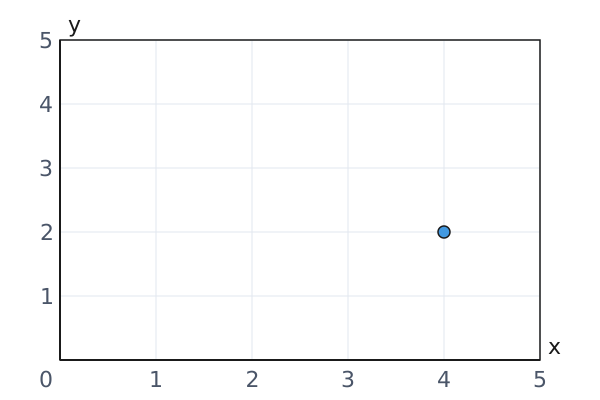
- The total distance from the origin to the point.
- The distance up from the x-axis.
- The distance right from the y-axis.
How you can help
- Draw a simple map grid of your street or a park, with the origin at one corner. Take turns naming coordinates for spots like a bench or a tree.
- Point out four-sided shapes in windows, tiles, and signs. Ask your child for every name each shape could have, and which property makes each name fit.
- Measure several crayons or pencils to the nearest eighth of an inch. Mark them on a line plot together, then find the difference between the longest and shortest.
Where kids can get stuck
- Starting from the last point plotted instead of the origin, so (4, 5) gets counted from (2, 3).
- Placing a square in only one group, so it goes under squares but not under rectangles or rhombuses.
- Spacing the fraction marks unevenly on a line plot, so 1/8 to 1/4 looks as far as 1/4 to 1/2.
Practice makes perfect
Bobby's Math Club has practice problems that adapt to your child’s level, each with a detailed explanation and an easy-to-follow video, so your child can build confidence in these skills one step at a time.
Words your child will hear
- coordinate grid
- A grid with numbered lines across and up, used to locate points.
- origin
- The point (0, 0), where the two axes meet.
- ordered pair
- Two numbers in order, like (6, 3), that name one point on a grid.
- quadrilateral
- Any closed flat shape with 4 straight sides.
- parallelogram
- A quadrilateral with two pairs of parallel sides.
- rhombus
- A parallelogram with 4 equal sides.
- hierarchy
- A family tree that shows how groups fit inside bigger groups.
- line plot
- A number line with Xs above it showing how often each value appears.
- data
- Information collected, often numbers or measurements.
Ready to build your child’s confidence with graphs, shapes, and data?
In Bobby's Math Club, your child practices these skills at just the right level, with a hint when they need one, a clear explanation after every question, and kid-friendly videos. Unlimited practice is free.
Join the club
Written by Robert “Bobby” Barnett
Bobby is an award-winning math teacher, the author of Meet Every Learner’s Needs, and the father of two elementary-school math learners. He uses Bobby’s Math Club with his own kids a few times every week. Learn more or contact Bobby.
Which math standards does Into Math Grade 5 Unit 6 cover?
Into Math Grade 5 Unit 6 covers these math standards. Each one links to what it means, sample questions, and teaching strategies.
- 5.G.A.1: Find and plot points on a coordinate grid, like (6, 3).
- 5.G.A.2: Graph points on a coordinate grid to solve real-life problems.
- 5.G.B.3: Know that a square has everything a rectangle has, because it is one.
- 5.G.B.4: Sort shapes into families by their sides and angles.
- 5.MD.B.2: Use line plots marked in fractions to solve problems in several steps.
For teachers: Unit names and order vary between editions and districts, so your school’s own materials have the exact sequence. Learn how Bobby's Math Club can help your students grow.