
Finding points on a grid, like (6, 3)
In 5th grade, children learn to locate points on a coordinate grid, reading (6, 3) as six steps from 0 along the x-axis and three steps up the y-axis, so 6 is its x-coordinate.

By Robert “Bobby” BarnettMath teacher, parent, and founder of Bobby’s Math Club
Try these with your child
These are real questions from our 5th grade practice. Tap the speaker to hear one read aloud, or the light bulb for a hint, and talk about the answer together.
Question 1 of 3
In the coordinate plane, the point (4, 2) is plotted. What does the number 2 in this ordered pair represent?
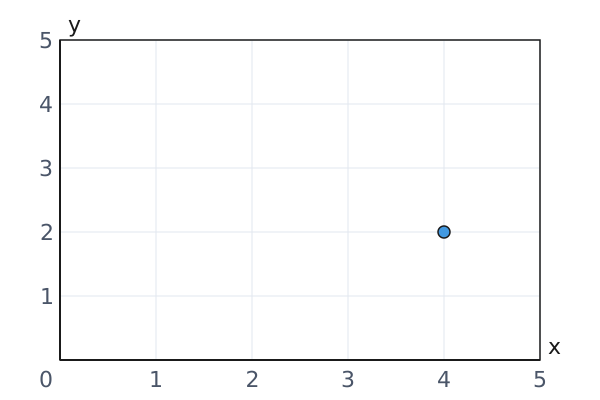
- The total distance from the origin to the point.
- The distance up from the x-axis.
- The distance right from the y-axis.
Why this matters
The coordinate grid is where numbers and pictures meet, and your child will use it through the rest of their math education. Next year it extends to negative numbers, and in middle and high school every graph of a relationship sits on one. Getting the order right, across first and then up, saves a lot of confusion when (6, 3) and (3, 6) start to matter.
Where kids can get stuck
- Going up first and then across, so the point (6, 3) gets plotted where (3, 6) belongs.
- Starting the count at 1 at the origin instead of 0, so every point lands one step too far each way.
- Starting each point from the last one instead of the origin, so (4, 5) gets counted from (2, 3).
How you can help
- Draw a simple grid on paper and play a hide-and-seek game: hide a small treasure at a point and give your child its coordinates, or let them hide one and tell you where to look.
- Draw a grid on graph paper, label the bottom line x and the side line y, and write 0 where they meet. Call out a point like (2, 5) and ask your child which number goes with the x-axis before they plot it.
- Use a tiled floor or a checkerboard as a giant grid. Pick a corner as the origin and call out coordinates for your child to walk to, reminding them to go across first.
If it’s helpful, you can sign up for free, adaptive practice in Bobby's Math Club.
Questions parents ask
Why is my child learning coordinate grids this way?
A coordinate grid is built from two number lines, which your child already understands. Teachers connect the two so locating points feels like a natural extension of counting along a line. Starting with the first quadrant, where all numbers are positive, keeps the focus on the key ideas: start at the origin and go across before going up.
How can my child remember which number comes first?
Many teachers use a phrase like "walk before you climb," meaning move across along the horizontal axis first, then up. Some families compare it to walking to a ladder before climbing it. Repeated practice plotting and reading points, especially in games, builds the habit until the order becomes automatic.
What comes after plotting points in the first quadrant?
Later in 5th grade, your child uses coordinates to graph real-world data and patterns. In 6th grade, they extend the grid in every direction to include negative numbers, which creates four sections called quadrants. In middle school, coordinates are used to graph equations and relationships, so a solid start now is very helpful.
Make learning math fun
Bobby's Math Club turns 5th grade math practice into something fun to do together.
- Free, unlimited practice for every child in your family
- Practice that starts where your child is and grows with them
- You see their progress and what to work on next

Written by Robert “Bobby” Barnett
Bobby is an award-winning math teacher, the author of Meet Every Learner’s Needs, and the father of two elementary-school math learners. He uses Bobby’s Math Club with his own kids a few times every week. Learn more or contact Bobby.
Ready to watch your child’s confidence grow?
Your 5th grade child can start today with free, unlimited practice that grows with them.
Join the clubNote for teachers: This skill is covered by Common Core math standard 5.G.A.1: “Use a pair of perpendicular number lines, called axes, to define a coordinate system, with the intersection of the lines (the origin) arranged to coincide with the 0 on each line and a given point in the plane located by using an ordered pair of numbers, called its coordinates. Understand that the first number indicates how far to travel from the origin in the direction of one axis, and the second number indicates how far to travel in the direction of the second axis, with the convention that the names of the two axes and the coordinates correspond (e.g., x-axis and x-coordinate, y-axis and y-coordinate).” Learn how Bobby's Math Club can help your students grow. (Common Core 5.G.1)