
Multiplying fractions, like 2/3 × 4/5
In 5th grade, children learn to multiply by a fraction, like 2/3 × 4/5 or 5/8 × 16, by thinking of "a fraction of" an amount; and to find the area of a rectangle with fraction sides.

By Robert “Bobby” BarnettMath teacher, parent, and founder of Bobby’s Math Club
Try these with your child
These are real questions from our 5th grade practice. Tap the speaker to hear one read aloud, or the light bulb for a hint, and talk about the answer together.
Question 1 of 3
The blue part of the rectangle shows 1/3 × 2/5, and the whole rectangle is 1. What is 1/3 × 2/5?
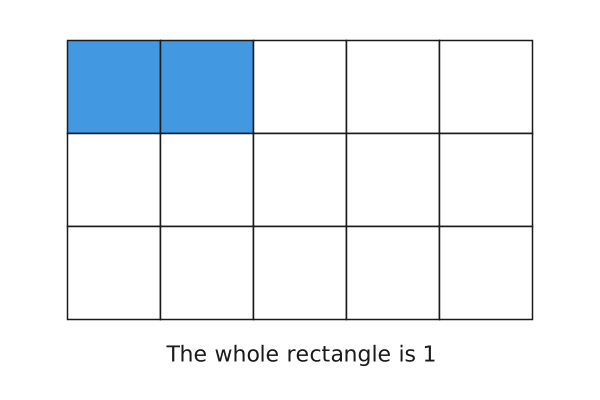
- 2/15
- 2/13
- 3/8
Why this matters
Multiplying fractions puts real tools in your child's hands: finding half of a recipe, three quarters of a price, or the area of a 1/2 foot by 3/4 foot tile. Understanding "a fraction of" an amount is also what makes dividing fractions in 6th grade, and percentages and probability after that, make sense. Without it, those topics can turn into rules applied without knowing why.
Where kids can get stuck
- Multiplying the whole number by the top and bottom, so 3 × 2/5 becomes 6/15, the same size as 2/5, instead of 6/5.
- Reading "1/2 of 3/4" as addition and answering 5/4, instead of a number smaller than 3/4, which is 3/8.
- Finding a common denominator before multiplying, as for adding, which makes the work longer and invites errors.
How you can help
- Halve a recipe together. If cookies need 3/4 cup of butter and you want half a batch, ask your child how much butter to use. Measure out 3/8 cup to check the answer looks like half.
- Ask "fraction of" questions with a carton of 12 eggs: what is 1/3 of 12? What is 3/4 of 12? Let your child count out the eggs to see that 3/4 of 12 is 9.
- Call a square napkin 1 square foot and fold it into a 4 by 4 grid. Shade a rectangle 3/4 foot long and 1/2 foot wide, then have your child count its 6 small squares and check that 3/4 × 1/2 = 6/16.
Bobby's Math Club offers free practice that grows with your child.
Questions parents ask
Why is my child learning to multiply fractions with drawings?
Drawings show why multiplying 1/2 by 3/4 gives a smaller amount, 3/8, which surprises many children. Shading part of a part makes the answer visible. Once your child understands that, the shortcut of multiplying numerators and denominators makes sense and is less likely to be confused with the rule for adding fractions.
Why is multiplying fractions easier than adding them?
When multiplying, you do not need a common denominator. You multiply the tops and multiply the bottoms, so 2/3 × 4/5 = 8/15. Many children are surprised by this and try to find a common denominator anyway, out of habit. Understanding that multiplying means taking a fraction of an amount explains why the rules are different.
What does 5/8 × 16 mean in everyday terms?
It means 5/8 of 16. If you have 16 ounces of juice and pour out 5/8 of it, how much did you pour? Split 16 into 8 equal parts of 2 ounces, then take 5 of those parts, which is 10 ounces. Framing problems as "part of an amount" helps your child picture the answer.
Make learning math fun
Bobby's Math Club turns 5th grade math practice into something fun to do together.
- Unlimited practice, completely free
- Practice that starts where your child is and grows with them
- You see their progress and what to work on next

Written by Robert “Bobby” Barnett
Bobby is an award-winning math teacher, the author of Meet Every Learner’s Needs, and the father of two elementary-school math learners. He uses Bobby’s Math Club with his own kids a few times every week. Learn more or contact Bobby.
Ready to watch your child’s confidence grow?
Your 5th grade child can start today with free, unlimited practice that grows with them.
Join the clubNote for teachers: This skill is covered by Common Core math standard 5.NF.B.4: “Apply and extend previous understandings of multiplication to multiply a fraction or whole number by a fraction. a. Interpret the product (a/b) × q as a parts of a partition of q into b equal parts; equivalently, as the result of a sequence of operations a × q ÷ b. For example, use a visual fraction model to show (2/3) × 4 = 8/3, and create a story context for this equation. Do the same with (2/3) × (4/5) = 8/15. (In general, (a/b) × (c/d) = ac/bd.) b. Find the area of a rectangle with fractional side lengths by tiling it with unit squares of the appropriate unit fraction side lengths, and show that the area is the same as would be found by multiplying the side lengths. Multiply fractional side lengths to find areas of rectangles, and represent fraction products as rectangular areas.” Learn how Bobby's Math Club can help your students grow. (Common Core 5.NF.4)