
5th Grade · Number & Operations - Fractions
5.NF.B.4: Multiply fractions, like 2/3 × 4/5 or 5/8 × 16
5.NF.B.4 is a 5th grade Common Core math standard in Number & Operations - Fractions. Here’s what it really covers, and how you can help your students learn it.

By Robert “Bobby” BarnettMath teacher, parent, and founder of Bobby’s Math Club
The standard
Apply and extend previous understandings of multiplication to multiply a fraction or whole number by a fraction. a. Interpret the product (a/b) × q as a parts of a partition of q into b equal parts; equivalently, as the result of a sequence of operations a × q ÷ b. For example, use a visual fraction model to show (2/3) × 4 = 8/3, and create a story context for this equation. Do the same with (2/3) × (4/5) = 8/15. (In general, (a/b) × (c/d) = ac/bd.) b. Find the area of a rectangle with fractional side lengths by tiling it with unit squares of the appropriate unit fraction side lengths, and show that the area is the same as would be found by multiplying the side lengths. Multiply fractional side lengths to find areas of rectangles, and represent fraction products as rectangular areas.
In plain words
Multiply fractions, like 2/3 × 4/5 or 5/8 × 16.
Sample questions from student practice
These questions from Bobby's Math Club are the kinds of questions your students will see. You can try answering them to see what a student might see.
Question 1 of 3
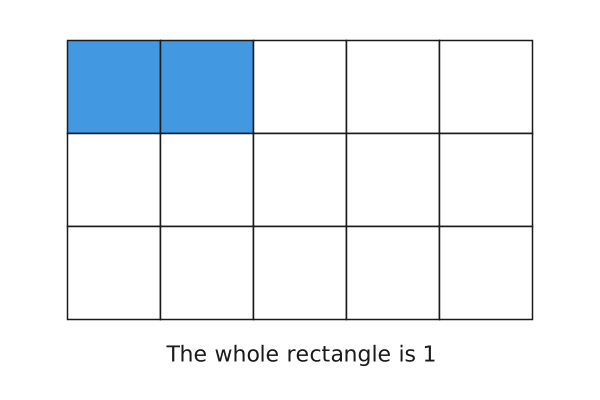
The blue part of the rectangle shows 1/3 × 2/5, and the whole rectangle is 1. What is 1/3 × 2/5?
- 2/15
- 2/13
- 3/8
Where students can get stuck
- Multiplying the whole number by the top and bottom, so 3 × 2/5 becomes 6/15, the same size as 2/5, instead of 6/5.
- Reading "1/2 of 3/4" as addition and answering 5/4, instead of a number smaller than 3/4, which is 3/8.
- Finding a common denominator before multiplying, as for adding, which makes the work longer and invites errors.
Effective teaching strategies
- Fold a paper strip to find 1/2 of 3/4 by shading 3/4 first and then folding the shaded part in half, so students see the answer is 3/8.
- Show 3 × 2/5 as three copies of 2/5 adding to 6/5, and ask why only the numerator is multiplied while the denominator names the piece size.
- Have students draw a rectangle split into thirds one way and fifths the other, shade 2/3 by 4/5, and count 8 of 15 small parts to see why the denominators multiply.
Units that teach this standard
Find where 5.NF.B.4 lands in the program you teach. Each unit has a guide written for families. Unit names and order vary between editions and districts, so your school’s own materials have the exact sequence.
Bridges in Mathematics
enVision Mathematics
Eureka Math
Everyday Mathematics
i-Ready Classroom Mathematics
Illustrative Mathematics
Math Expressions
Reveal Math
Don’t see your curriculum? Contact Bobby and we’ll see if we can help!
Share it with families
Families can read Multiplying fractions, like 2/3 × 4/5 for a plain-language look at this skill, with three questions to try together and ideas for helping at home.
Help every student practice fractions at home
In Bobby's Math Club, students practice at just the right level, with a hint when they need one, a clear explanation after every question, and kid-friendly videos. Unlimited practice is free for every family.
See how it works for teachers
Written by Robert “Bobby” Barnett
Bobby is an award-winning math teacher, the author of Meet Every Learner’s Needs, and the father of two elementary-school math learners. He uses Bobby’s Math Club with his own kids a few times every week. Learn more or contact Bobby.