
Zearn Math Grade 5, Mission 5: Volume, Area, and Shapes
In this unit, your child finds volume by packing rectangular prisms with unit cubes, then by multiplying length × width × height, and adds the volumes of joined boxes. They find the area of rectangles with fractional side lengths, like 2 1/2 by 1 1/2, by tiling and by multiplying. Then they draw trapezoids, parallelograms, rhombuses, kites, and squares and sort them into a hierarchy by their properties. Next comes the coordinate plane.

By Robert “Bobby” BarnettMath teacher, parent, and founder of Bobby’s Math Club
Sample questions to try together
These are real questions from our practice. Tap the speaker to hear one read aloud, or the light bulb for a hint, and talk about the answer together.
Question 1 of 3
The blue part of the rectangle shows 1/3 × 2/5, and the whole rectangle is 1. What is 1/3 × 2/5?
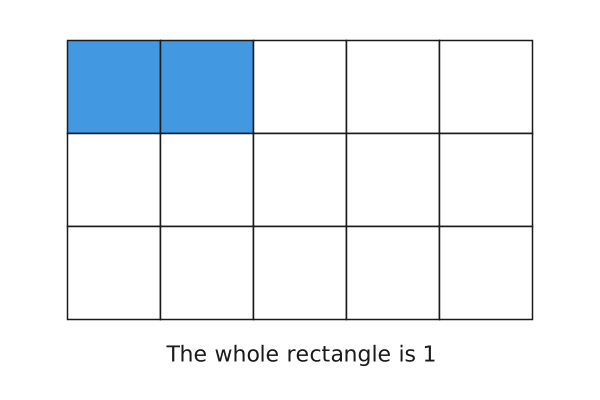
- 2/15
- 2/13
- 3/8
What is my child learning in Mission 5?
- Finding the area of a rectangle with fractional sides, like 2 1/2 by 1 1/2, by tiling it with unit squares and by multiplying. Learn more: Multiplying fractions, like 2/3 × 4/5
- Solving real-world area problems with mixed-number side lengths, like painting a 4 1/2 by 3 foot wall, using drawings or equations. Learn more: Multiplying fractions in real life, like recipes
- Describing volume as the number of unit cubes that pack a solid with no gaps or overlaps. Learn more: Volume: how much space is inside a solid
- Measuring volume by counting cubic centimeters or cubic inches in layers, including cubes hidden from view. Learn more: Finding volume by counting cubes
- Using V = l × w × h and V = B × h to find volumes, and adding the volumes of two boxes put together. Learn more: Finding the volume of a box
- Seeing that a shape shares the properties of every group it belongs to, so every square is also a rectangle and a rhombus. Learn more: Why a square is also a rectangle
- Sorting quadrilaterals such as trapezoids, parallelograms, and kites into a hierarchy by parallel sides, equal sides, and angles. Learn more: Sorting four-sided shapes into a family tree
How you can help
- Build an L-shaped figure from blocks or dice, made of two boxes side by side. Ask your child to find each box's volume and add them.
- Measure a placemat, a cereal box, or a book cover to the nearest half inch. Ask your child to find its area by multiplying the mixed numbers.
- Draw a few four-sided shapes on paper and ask your child to name every group each one belongs to, such as square, rectangle, rhombus, and parallelogram.
Where kids can get stuck
- Using the whole shape's length for one part when splitting an L-shaped figure, so some cubes get counted twice.
- Multiplying only the whole-number parts, so a 3 1/2 by 2 rectangle gets an area of 6 instead of 7.
- Thinking a square is not a rectangle, because the rectangles they have seen are longer than they are wide.
Practice makes perfect
Bobby's Math Club has practice problems that adapt to your child’s level, each with a detailed explanation and an easy-to-follow video, so your child can build confidence in these skills one step at a time.
Words your child will hear
- volume
- The amount of space inside a solid shape, measured in cubic units.
- unit cube
- A cube that is 1 unit long, 1 unit wide, and 1 unit tall.
- cubic unit
- The unit for measuring volume: the space one unit cube fills.
- rectangular prism
- A solid shape with six rectangle faces, like a box.
- area
- The number of square units that cover a flat shape.
- mixed number
- A whole number and a fraction together, like 2 1/2.
- quadrilateral
- Any flat shape with four straight sides.
- trapezoid
- A four-sided shape with at least one pair of parallel sides.
- parallelogram
- A four-sided shape with two pairs of parallel sides.
Want to help your child with volume, area, and shapes?
In Bobby's Math Club, your child practices volume, area, and shapes at just the right level, with a hint when they need one, a clear explanation after every question, and kid-friendly videos. Unlimited practice is free.
Join the clubCurious about your child’s level?
Take a free placement test →
Written by Robert “Bobby” Barnett
Bobby is an award-winning math teacher, the author of Meet Every Learner’s Needs, and the father of two elementary-school math learners. He uses Bobby’s Math Club with his own kids a few times every week. Learn more or contact Bobby.
Which math standards does Zearn Math Grade 5 Mission 5 cover?
Zearn Math Grade 5 Mission 5 covers these math standards. Each one links to what it means, sample questions, and teaching strategies.
- 5.NF.B.4: Multiply fractions, like 2/3 × 4/5 or 5/8 × 16.
- 5.NF.B.6: Solve word problems that multiply fractions and mixed numbers.
- 5.MD.C.3: Understand volume: how many cubes it takes to fill a solid shape.
- 5.MD.C.4: Find the volume of a shape by counting cubes.
- 5.MD.C.5: Find the volume of a box by multiplying its length, width, and height.
- 5.G.B.3: Know that a square has everything a rectangle has, because it is one.
- 5.G.B.4: Sort shapes into families by their sides and angles.
For teachers: Unit names and order vary between editions and districts, so your school’s own materials have the exact sequence. Learn how Bobby's Math Club can help your students grow.