
Finding volume by counting cubes
In 5th grade, children learn to measure volume by counting unit cubes, using cubic centimeters, cubic inches, cubic feet, and everyday objects as units.

By Robert “Bobby” BarnettMath teacher, parent, and founder of Bobby’s Math Club
Try these with your child
These are real questions from our 5th grade practice. Tap the speaker to hear one read aloud, or the light bulb for a hint, and talk about the answer together.
Question 1 of 3
Nia builds a wall for her play fort from foam cubes that are 1 foot on each side. The wall is one cube thick. What is the volume of the wall?
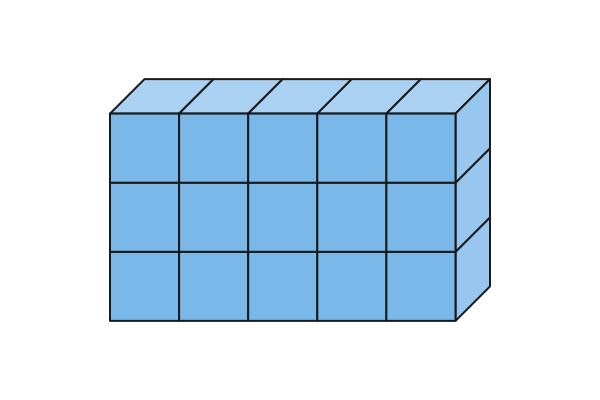
- 23 cubic feet
- 15 cubic feet
- 9 cubic feet
Why this matters
Counting cubes shows your child what a volume number really means, so the formula that comes next is not a string of letters to memorize. Working with cubic inches, cubic centimeters, and cubic feet also teaches that the size of the unit changes the count. That understanding supports surface area and volume work in 6th grade and measuring in science classes.
Where kids can get stuck
- Counting only the cubes they can see, so a 3 by 4 by 2 stack is counted as 20 or fewer, not 24.
- Writing square inches instead of cubic inches, mixing up the unit for flat surfaces with the unit for solid space.
- Counting each outside face separately and adding, so corner and edge cubes get counted two or three times.
How you can help
- Build a rectangular block with toy bricks or sugar cubes, then ask your child to count how many cubes it took. Encourage them to count one layer and then the number of layers.
- Find how many of one item fit in a container, such as tissue boxes in a closet shelf or juice boxes in a cooler. Talk about this as measuring volume with an everyday unit.
- Use a ruler to measure a small box, like a tea or jewelry box, in inches. Ask your child to picture how many inch cubes would fill it along the bottom and how many layers high.
Want a little more? Try Bobby's Math Club for free practice that adapts to your child.
Questions parents ask
Why is my child counting cubes instead of using a formula?
Counting cubes shows exactly what volume measures: the number of unit cubes that fill a space. When your child counts layer by layer, they discover that a 3 by 4 layer has 12 cubes and two layers have 24. That discovery is what makes the length × width × height formula sensible when it arrives later this year.
Why does my child miss cubes when counting from a picture?
Drawings show only the front, top, and one side of a stack, so some cubes are hidden. Many children count only what they see. Building the same shape with real blocks and then comparing with the drawing helps. Counting by layers, rather than one cube at a time, also keeps hidden cubes from being missed.
Why do schools use improvised units like boxes or blocks?
Improvised units show that volume is about filling space, whatever size the unit is. Counting juice boxes in a cooler or blocks in a bin builds the same idea as cubic inches. It also shows why everyone agrees on standard units: different-size blocks give different counts for the same container.
Make learning math fun
Bobby's Math Club turns 5th grade math practice into something fun to do together.
- Unlimited practice, completely free
- Practice that starts where your child is and grows with them
- Hints when they are stuck, and a celebration when it clicks

Written by Robert “Bobby” Barnett
Bobby is an award-winning math teacher, the author of Meet Every Learner’s Needs, and the father of two elementary-school math learners. He uses Bobby’s Math Club with his own kids a few times every week. Learn more or contact Bobby.
Ready to watch your child’s confidence grow?
Your 5th grade child can start today with free, unlimited practice that grows with them.
Join the clubNote for teachers: This skill is covered by Common Core math standard 5.MD.C.4: “Measure volumes by counting unit cubes, using cubic cm, cubic in, cubic ft, and improvised units.” Learn how Bobby's Math Club can help your students grow. (Common Core 5.MD.4)