
Measurement charts with halves, quarters, and eighths
In 5th grade, children learn to make line plots of measurements in halves, quarters, and eighths; and to add, subtract, and share those fractions to answer questions about the data.

By Robert “Bobby” BarnettMath teacher, parent, and founder of Bobby’s Math Club
Try these with your child
These are real questions from our 5th grade practice. Tap the speaker to hear one read aloud, or the light bulb for a hint, and talk about the answer together.
Question 1 of 3
Each X shows the side length of one square picture frame in the art room. The marks on the line are 1/4 foot apart. What is the distance around the largest frame?
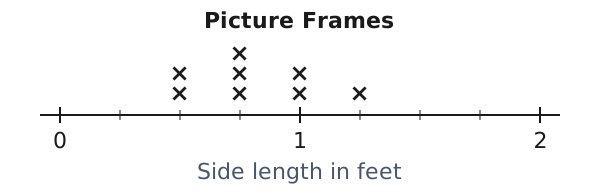
- 1 9/16 square feet
- 5 feet
- 2 1/2 feet
Why this matters
Line plots give your child's fraction arithmetic a real job, like finding total rainfall or the difference between two measurements, and they build comfort reading a ruler to the eighth of an inch. They lead into the data displays of 6th grade, where your child will describe a set of numbers with ideas like the average and the middle value, and into science, where measurements are rarely whole numbers.
Where kids can get stuck
- Spacing the fraction marks unevenly, so 1/8 and 1/4 end up as far apart as 1/4 and 1/2.
- Counting the Xs when asked for a total, saying six days of rain made 6 inches instead of adding to 1 3/4 inches.
- Placing 3/8 in the wrong spot, often after 1/2, because they are unsure it falls between 1/4 and 1/2.
How you can help
- Measure the lengths of several leaves, pencils, or crayons from around the house to the nearest 1/4 inch. Help your child make a quick line plot on scrap paper and ask which length came up most often.
- Track something over a week, like how much of a glass of milk is left after breakfast, using halves and quarters. At the end, ask your child to add up the total left over.
- After making a line plot together, ask a sharing question: if all the measured string pieces were joined and cut into equal parts for each family member, how long would each part be?
Bobby's Math Club offers free practice that grows with your child.
Questions parents ask
Why is my child learning line plots with fractions?
Real measurements are rarely whole numbers, and line plots let your child organize fractional data in a way that shows patterns. Using a ruler to measure in eighths and then plotting the results gives fraction work a real purpose. The follow-up questions, like finding totals and differences, let your child practice fraction arithmetic in context.
What kind of questions will my child answer about a line plot?
Typical questions ask for the total of all measurements, the difference between the largest and smallest, how many measurements are greater than a given amount, or how much each would be if the total were shared equally. Each question requires reading the plot carefully and choosing the right operation with fractions.
My child can draw the line plot but struggles with the questions. What helps?
Drawing the plot and using its data are separate skills. Encourage your child to list the measurements the question needs before calculating. For a total, they write each fraction with an X above it. Having them say the question in their own words also helps them choose whether to add, subtract, or share.
Make learning math fun
Bobby's Math Club turns 5th grade math practice into something fun to do together.
- Unlimited practice, completely free
- Practice that starts where your child is and grows with them
- Hints when they are stuck, and a celebration when it clicks

Written by Robert “Bobby” Barnett
Bobby is an award-winning math teacher, the author of Meet Every Learner’s Needs, and the father of two elementary-school math learners. He uses Bobby’s Math Club with his own kids a few times every week. Learn more or contact Bobby.
Ready to watch your child’s confidence grow?
Your 5th grade child can start today with free, unlimited practice that grows with them.
Join the clubNote for teachers: This skill is covered by Common Core math standard 5.MD.B.2: “Make a line plot to display a data set of measurements in fractions of a unit (1/2, 1/4, 1/8). Use operations on fractions for this grade to solve problems involving information presented in line plots. For example, given different measurements of liquid in identical beakers, find the amount of liquid each beaker would contain if the total amount in all the beakers were redistributed equally.” Learn how Bobby's Math Club can help your students grow. (Common Core 5.MD.2)