
Eureka Math² Grade 5, Module 3: Multiplication and Division with Fractions
In this unit, your child multiplies and divides with fractions: a fraction of a set, a whole number times a fraction, a fraction times a fraction, and division with unit fractions. A recurring question is whether multiplying will make the answer bigger or smaller. They also convert customary units, like feet to inches, and write expressions with parentheses for multi-step fraction problems. Decimals come next.

By Robert “Bobby” BarnettMath teacher, parent, and founder of Bobby’s Math Club
Sample questions to try together
These are real questions from our practice. Tap the speaker to hear one read aloud, or the light bulb for a hint, and talk about the answer together.
Question 1 of 3
The blue part of the rectangle shows 1/3 × 2/5, and the whole rectangle is 1. What is 1/3 × 2/5?
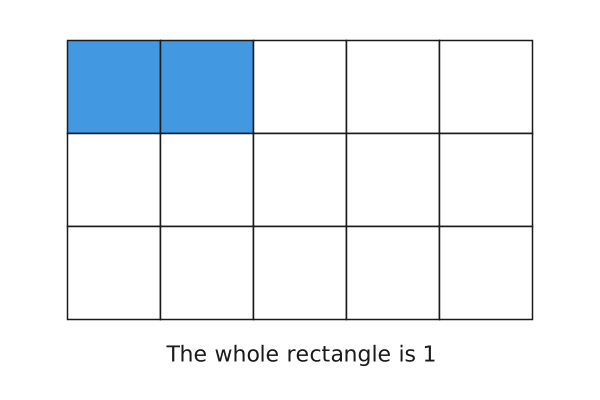
- 2/15
- 2/13
- 3/8
What is my child learning in Module 3?
- Multiplying fractions by whole numbers and by fractions, like 5/8 × 16 = 10 or 2/3 × 3/4 = 1/2. Learn more: Multiplying fractions, like 2/3 × 4/5
- Comparing a product to its factors without calculating, knowing that 5 × 4/3 is more than 5. Learn more: When multiplying makes a number smaller
- Solving word problems with fractions and mixed numbers, like walking 3/4 of a 2 2/3-mile trail. Learn more: Multiplying fractions in real life, like recipes
- Dividing unit fractions by whole numbers and whole numbers by unit fractions, like 1/3 ÷ 2 = 1/6 and 2 ÷ 1/5 = 10. Learn more: Dividing with fractions, like 1/2 ÷ 4
- Evaluating expressions with parentheses and brackets that include fractions, such as (1/2 + 1/4) × 8 = 6. Learn more: Solving number sentences with parentheses
- Writing expressions for fraction word problems, like 1/3 × (12 + 6), and comparing expressions without solving them. Learn more: Turning words into number sentences
- Converting customary units, such as 3 feet to 36 inches or 2 1/2 pounds to 40 ounces, using fraction multiplication. Learn more: Converting feet to yards and grams to kilograms
How you can help
- Talk fractions on a walk: if the whole route is 2 miles and you have done 3/4 of it, how far have you gone? Let your child find 1 1/2 miles.
- Ask how many 1/5-hour chunks fit in a 2-hour afternoon. Let your child predict, then check that 2 ÷ 1/5 is 10 chunks of 12 minutes each.
- Ask how many inches are in 2 1/2 feet, and let your child multiply 2 1/2 × 12 to find 30.
Where kids can get stuck
- Finding a common denominator before multiplying, as for adding, which makes the work longer and invites errors.
- Expecting division to shrink a number, so 2 ÷ 1/5 becomes 2/5 instead of 10.
- Expecting multiplying to make a number bigger, so 1/2 × 6 seems like it should be more than 6.
Practice makes perfect
Bobby's Math Club has practice problems that adapt to your child’s level, each with a detailed explanation and an easy-to-follow video, so your child can build confidence in these skills one step at a time.
Words your child will hear
- numerator
- In 3/4, the 3: the number of equal parts being counted.
- denominator
- In 3/4, the 4: the number of equal parts the whole is cut into.
- quotient
- What you get when you divide one number by another.
- product
- What you get when you multiply numbers together.
- factor
- One of the numbers being multiplied, like 6 or 4 in 6 × 4.
- unit fraction
- One equal part of a whole, like 1/4.
- scaling
- Thinking of multiplication as stretching or shrinking an amount.
- mixed number
- A whole number and a fraction together, like 2 1/2.
- expression
- Numbers and operation signs written together to show a calculation, like 1/2 × (4 + 2).
Want to help your child with multiplying and dividing fractions?
In Bobby's Math Club, your child practices multiplying and dividing fractions at just the right level, with a hint when they need one, a clear explanation after every question, and kid-friendly videos. Unlimited practice is free.
Join the clubCurious about your child’s level?
Take a free placement test →
Written by Robert “Bobby” Barnett
Bobby is an award-winning math teacher, the author of Meet Every Learner’s Needs, and the father of two elementary-school math learners. He uses Bobby’s Math Club with his own kids a few times every week. Learn more or contact Bobby.
Which math standards does Eureka Math² Grade 5 Module 3 cover?
Eureka Math² Grade 5 Module 3 covers these math standards. Each one links to what it means, sample questions, and teaching strategies.
- 5.NF.B.4: Multiply fractions, like 2/3 × 4/5 or 5/8 × 16.
- 5.NF.B.5: See how multiplying by a fraction can make a number bigger or smaller.
- 5.NF.B.6: Solve word problems that multiply fractions and mixed numbers.
- 5.NF.B.7: Divide with fractions, like 1/2 ÷ 4 and 5 ÷ 1/3.
- 5.OA.A.1: Solve problems with parentheses and brackets, working inside first.
- 5.OA.A.2: Turn words into calculations like (5 + 7) × 3, and explain them.
- 5.MD.A.1: Convert between units, like feet and yards, to solve problems.
For teachers: Unit names and order vary between editions and districts, so your school’s own materials have the exact sequence. Learn how Bobby's Math Club can help your students grow.