
Math Expressions Grade 3, Unit 3: Measurement, Time, and Graphs
In this unit, your child tells time to the minute, finds elapsed time, measures mass and liquid volume, measures lengths to the quarter inch, and reads and makes picture graphs, bar graphs, and line plots. Multiplication facts from the last units help with graph scales, and the next unit turns to adding and subtracting larger numbers.

By Robert “Bobby” BarnettMath teacher, parent, and founder of Bobby’s Math Club
What is my child learning in Unit 3?
- Reading clocks to the exact minute and working out start times, end times, and elapsed time on a number line. Learn more about telling time to the minute: Telling time to the minute · Learn more about working out how many minutes have passed
- Estimating and measuring mass in grams and kilograms and liquid volume in liters, and solving problems with those measurements. Learn more: Weighing things and measuring liquids
- Reading and making scaled picture graphs and bar graphs, where one symbol might stand for 2, 5, or 10. Learn more: Reading picture graphs and bar graphs
- Measuring lengths to the nearest half or quarter inch and organizing those measurements on a line plot. Learn more: Measuring to the nearest quarter inch
Sample questions to try together
These are real questions from our practice. Tap the speaker to hear one read aloud, or the light bulb for a hint, and talk about the answer together.
Question 1 of 3
The school play starts 20 minutes after the time shown on the clock. What time does the school play begin?
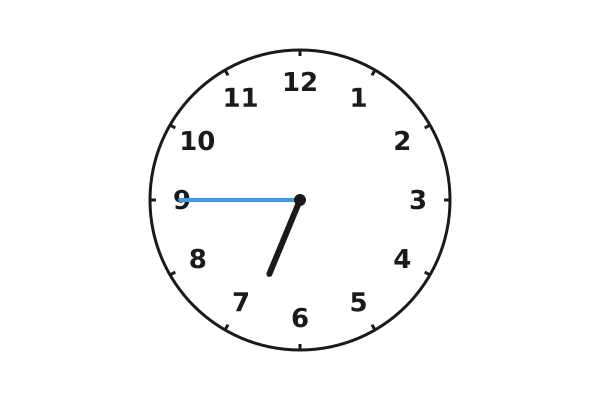
- 6:25 p.m.
- 7:05 p.m.
- 7:00 p.m.
How you can help
- Time a short task, such as getting ready for bed, and ask your child to find the elapsed time from start to finish on a clock with hands.
- Compare items in the kitchen: hold a 1-kilogram bag and a 100-gram packet, then pour a 1-liter bottle of water into cups, estimating first how many it will fill.
- Measure a few crayons or spoons to the nearest quarter inch, then make a line plot of the lengths together and ask which length came up most.
Where kids can get stuck
- Misreading the hour hand when it is close to the next number, so 2:55 is read as 3:55.
- Picking the wrong unit for an estimate, such as saying an apple has a mass of about 200 kilograms.
- Guessing at a bar that ends between grid lines, reading halfway between 10 and 20 as 11 instead of 15.
Practice makes perfect
Bobby's Math Club has practice problems that adapt to your child’s level, each with a detailed explanation and an easy-to-follow video, so your child can build confidence in these skills one step at a time.
Words your child will hear
- minute hand
- The long hand on a clock that points to the minutes.
- elapsed time
- How much time passes from the start of something to the end.
- mass
- How heavy something is, measured in grams or kilograms.
- gram
- A small unit of mass; a paper clip is about 1 gram.
- kilogram
- A unit of mass equal to 1,000 grams; a big dictionary is about 1 kilogram.
- liter
- A unit of liquid volume; a large water bottle holds about 1 liter.
- bar graph
- A graph that uses bars of different lengths to show and compare data.
- scale
- The numbers along a graph's side, or the marks on a measuring tool.
- line plot
- A number line with an X above it for each piece of data.
Ready to build your child’s confidence with time, measurement, and graphs?
In Bobby's Math Club, your child practices these skills at just the right level, with a hint when they need one, a clear explanation after every question, and kid-friendly videos. Unlimited practice is free.
Join the club
Written by Robert “Bobby” Barnett
Bobby is an award-winning math teacher, the author of Meet Every Learner’s Needs, and the father of two elementary-school math learners. He uses Bobby’s Math Club with his own kids a few times every week. Learn more or contact Bobby.
Which math standards does Math Expressions Grade 3 Unit 3 cover?
Math Expressions Grade 3 Unit 3 covers these math standards. Each one links to what it means, sample questions, and teaching strategies.
For teachers: Unit names and order vary between editions and districts, so your school’s own materials have the exact sequence. Learn how Bobby's Math Club can help your students grow.