
Math Expressions Grade 3, Unit 7: Explore Fractions
In this unit, your child explores fractions as numbers. Children name equal parts with a numerator and a denominator, place fractions on a number line, compare them, and find fractions that are equal. It builds on the area work of the last unit, where shapes are split into equal squares, and it closes third grade with a strong start on fractions.

By Robert “Bobby” BarnettMath teacher, parent, and founder of Bobby’s Math Club
What is my child learning in Unit 7?
- Naming a fraction like 5/6 as 5 parts of size 1/6, where the denominator, the bottom number, tells how many equal parts. Learn more: What a fraction like 3/4 means
- Locating fractions on a number line by dividing each whole into equal lengths and counting from 0. Learn more: Fractions on a number line
- Comparing fractions such as 2/3 and 2/6 by thinking about the size of the parts, and finding equivalent fractions. Learn more about finding equal fractions, like 1/2 = 2/4: Finding equal fractions, like 1/2 = 2/4 · Learn more about comparing fractions by size
Sample questions to try together
These are real questions from our practice. Tap the speaker to hear one read aloud, or the light bulb for a hint, and talk about the answer together.
Question 1 of 3
Tariq is painting this paper strip blue for a class banner. So far he has painted the blue parts. What fraction of the strip does he still need to paint?
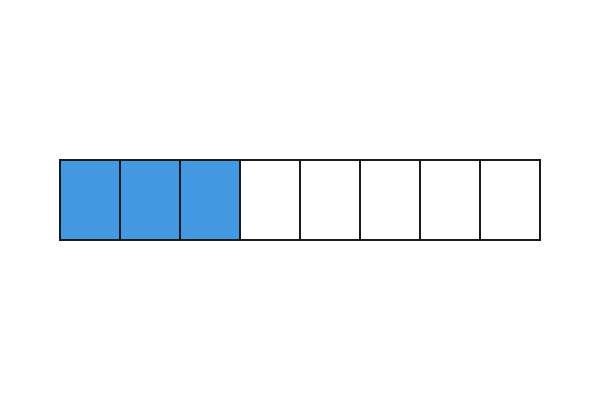
- 5/3
- 3/8
- 5/8
How you can help
- Share a pre-sliced pizza or a pan of cornbread cut into equal pieces and ask your child to name the fraction each person eats and the fraction left.
- Draw a number line from 0 to 2 in chalk on the sidewalk, mark it in thirds, and have your child hop to 2/3, 3/3, and 5/3.
- Ask 'Would you rather have 2/3 or 2/6 of a granola bar?' and let your child explain the choice using the size of the pieces.
Where kids can get stuck
- Labeling tick marks by counting the marks instead of the spaces, so thirds get labeled as fourths.
- Thinking 2/6 is greater than 2/3 because 6 is greater than 3.
- Writing shaded parts over unshaded parts, so 2 of 6 shaded parts becomes 2/4 instead of 2/6.
Practice makes perfect
Bobby's Math Club has practice problems that adapt to your child’s level, each with a detailed explanation and an easy-to-follow video, so your child can build confidence in these skills one step at a time.
Words your child will hear
- fraction
- A number that names equal parts of a whole, like 3/4.
- numerator
- The top number in a fraction; it tells how many equal parts are counted.
- denominator
- The bottom number in a fraction; it tells how many equal parts make the whole.
- unit fraction
- A fraction with 1 on top, like 1/3, naming one equal part.
- equal parts
- Parts of a whole that are all exactly the same size.
- number line
- A line with numbers marked in order at equal spaces.
- equivalent fractions
- Fractions that name the same amount, like 1/2 and 2/4.
- greater than
- More than; shown with the symbol >.
Want to help your child master exploring fractions?
In Bobby's Math Club, your child practices these skills at just the right level, with a hint when they need one, a clear explanation after every question, and kid-friendly videos. Unlimited practice is free.
Join the club
Written by Robert “Bobby” Barnett
Bobby is an award-winning math teacher, the author of Meet Every Learner’s Needs, and the father of two elementary-school math learners. He uses Bobby’s Math Club with his own kids a few times every week. Learn more or contact Bobby.
Which math standards does Math Expressions Grade 3 Unit 7 cover?
Math Expressions Grade 3 Unit 7 covers these math standards. Each one links to what it means, sample questions, and teaching strategies.
For teachers: Unit names and order vary between editions and districts, so your school’s own materials have the exact sequence. Learn how Bobby's Math Club can help your students grow.