
Pre-K · Geometry
PK.G.3: Compare 2D/3D shapes
PK.G.3 is a Pre-K math standard in Geometry. Here’s what it really covers, and how you can help your students learn it.

By Robert “Bobby” BarnettMath teacher, parent, and founder of Bobby’s Math Club
The Pre-K math learning standard
Analyze, compare, and sort two- and three-dimensional shapes and objects, in different sizes, using informal language to describe their similarities, differences, and other attributes (e.g., color, size, and shape).
In plain words
Compare 2D/3D shapes.
Sample questions from student practice
These questions from Bobby's Math Club are the kinds of questions your students will see. You can try answering them to see what a student might see.
Question 1 of 3
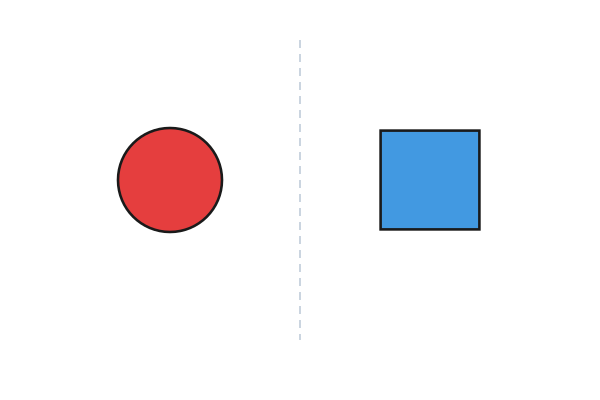
Look at these two shapes. Which one is a square?
- Neither one
- The blue shape
- The red shape
Where students can get stuck
- Sorting only by color or size, such as putting a red ball with a red block because both are red.
- Using flat shape names for solid objects, calling a ball a circle and a box a square.
- Sorting shapes correctly but explaining only "because they go together" when asked how they are alike.
Effective teaching strategies
- Sort the same group of large shapes and objects twice, once by color and once by shape, so students see that one group can be sorted in more than one way.
- Compare a ball with a paper circle and ask how they are alike and different, using words such as flat, round, and roll.
- Ask how the things in each group are alike after every sort and offer the sentence starter They both, so students give a reason such as both roll or both have corners.
Share it with families
Families can read Comparing and sorting flat and solid shapes for a plain-language look at this skill, with three questions to try together and ideas for helping at home.
Help every student practice geometry at home
In Bobby's Math Club, students practice at just the right level, with a hint when they need one, a clear explanation after every question, and kid-friendly videos. Unlimited practice is free for every family.
See how it works for teachers
Written by Robert “Bobby” Barnett
Bobby is an award-winning math teacher, the author of Meet Every Learner’s Needs, and the father of two elementary-school math learners. He uses Bobby’s Math Club with his own kids a few times every week. Learn more or contact Bobby.