
Comparing and sorting flat and solid shapes
In Pre-K, children learn to compare and sort flat shapes and solid objects of different sizes, and to describe in their own words how they are alike and different.

By Robert “Bobby” BarnettMath teacher, parent, and founder of Bobby’s Math Club
Try these with your child
These are real questions from our Pre-K practice. Tap the speaker to hear one read aloud, or the light bulb for a hint, and talk about the answer together.
Question 1 of 3
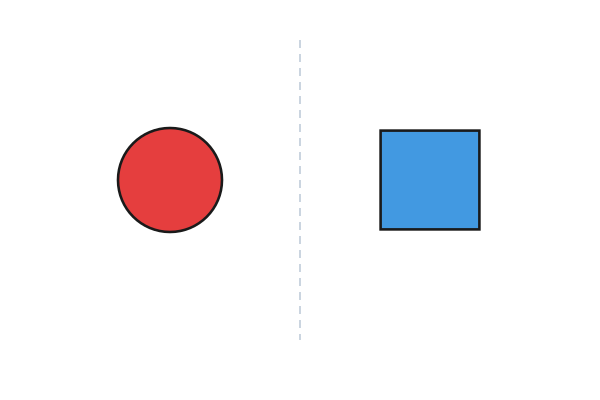
Look at these two shapes. Which one is a square?
- Neither one
- The blue shape
- The red shape
Why this matters
Comparing shapes sharpens your child's eye for features such as corners, roundness, and flatness, which is how geometry works in every grade after this. In kindergarten they will use the words flat and solid and talk about sides and corners, and by 1st grade they will tell which features make a shape what it is. Describing likenesses and differences in their own words also helps your child explain their thinking.
Where kids can get stuck
- Sorting only by color or size, such as putting a red ball with a red block because both are red.
- Using flat shape names for solid objects, calling a ball a circle and a box a square.
- Sorting shapes correctly but explaining only "because they go together" when asked how they are alike.
How you can help
- Collect a ball, an orange, a cereal box, and a can, and ask your child which ones can roll and which ones can stack, then talk about why.
- Trace around a cup on paper to show its flat circle, then compare the drawing with the cup itself and ask how they are different.
- Put a mix of toys in a basket and ask your child to sort them into round ones and ones with corners, explaining each choice.
The kid-friendly video below explains it in a few minutes, and Bobby's Math Club offers free practice that grows with your child.
Kid-friendly explanation
Questions parents ask
Why is my child learning to compare flat and solid shapes?
Comparing shapes trains your child to notice features such as roundness, corners, and flatness. Those observations are the start of geometry. Working with both flat shapes and solid objects also helps children see that a ball and a circle are related but not the same, which prepares them for naming two- and three-dimensional shapes in kindergarten.
My child calls a ball a circle. Should I correct them?
It is a very common mix-up, since a ball looks round like a circle. You can gently add to what your child says: "Yes, it is round like a circle, and it is a ball, so it is round all the way around." Comparing a paper circle with a ball by holding both helps your child feel that one is flat and one is not.
Does my child need to know words like cube and sphere yet?
Not yet. At this age, children describe shapes with their own words, such as round, pointy, flat, or bumpy. That informal talk builds understanding. Formal names for solid shapes, like cube, sphere, and cylinder, are usually introduced in kindergarten, once children have handled and compared many real objects.
Make learning math fun
Bobby's Math Club turns Pre-K math practice into something fun to do together.
- Unlimited practice, completely free
- Practice that starts where your child is and grows with them
- Hints when they are stuck, and a celebration when it clicks

Written by Robert “Bobby” Barnett
Bobby is an award-winning math teacher, the author of Meet Every Learner’s Needs, and the father of two elementary-school math learners. He uses Bobby’s Math Club with his own kids a few times every week. Learn more or contact Bobby.
Ready to watch your child’s confidence grow?
Your Pre-K child can start today with free, unlimited practice that grows with them.
Join the clubNote for teachers: This skill is covered by the Pre-K math learning standard PK.G.3: “Analyze, compare, and sort two- and three-dimensional shapes and objects, in different sizes, using informal language to describe their similarities, differences, and other attributes (e.g., color, size, and shape).” Learn how Bobby's Math Club can help your students grow. (Pre-K standard PK.G.3)