
Sorting things into groups and counting them
In Pre-K, children learn to sort objects into groups by a shared feature, such as color or kind, and to count how many are in each group, up to 10.

By Robert “Bobby” BarnettMath teacher, parent, and founder of Bobby’s Math Club
Try these with your child
These are real questions from our Pre-K practice. Tap the speaker to hear one read aloud, or the light bulb for a hint, and talk about the answer together.
Question 1 of 3
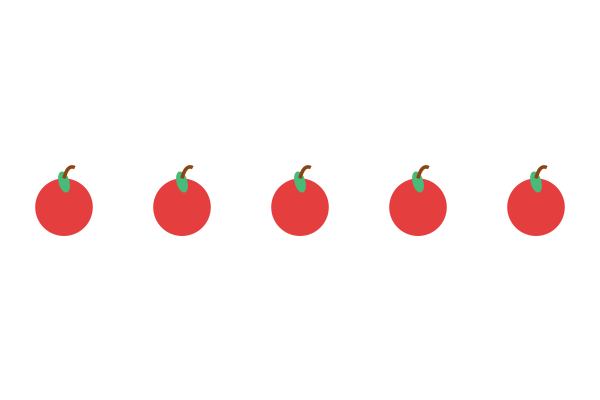
How many apples do you see?
- 6
- 4
- 5
Why this matters
Sorting and counting is your child's first taste of working with information. Once groups are counted, your child can say which has more, the idea behind every chart and graph they will read later. In kindergarten they will put sorted groups in order by size, and by 1st and 2nd grade they will record counts in simple tables, picture graphs, and bar graphs and answer questions about them.
Where kids can get stuck
- Changing the sorting rule partway through, such as putting a blue truck with the cars because it is a vehicle.
- Counting the whole pile instead of each group, and giving one total instead of a number per group.
- Leaving out objects that do not seem to fit, so the group counts do not add up to the whole.
How you can help
- Ask your child to sort clean socks into piles by color, then count how many are in each pile and tell you which pile is bigger.
- Empty a small bag of mixed snacks and sort it into groups, such as crackers and raisins, counting each group before eating.
- Sort toy animals into those that live on a farm and those that do not, then count each group together and talk about the rule you used.
Want a little more? Watch the kid-friendly video below together, or try Bobby's Math Club for free practice that adapts to your child.
Kid-friendly explanation
Questions parents ask
Why is my child learning to sort as part of math?
Sorting teaches children to notice what objects have in common and how they differ, which is the start of classifying. When they count each group, the sorting becomes information they can use, such as knowing which group is bigger. This is an early form of organizing data, a skill that grows into tally charts and graphs in later grades.
My child sorts but keeps changing the rule. Is that normal?
Yes. Young children notice many features at once, so a blue car might seem to belong with the blue things and with the cars. Before starting, agree on the rule together: "We are sorting by color." Halfway through, ask your child to remind you of the rule. Holding one rule in mind gets easier with practice.
Why are the groups limited to 10 objects?
Pre-K children are still building their counting skills, and groups of 10 or fewer let them count accurately and check their answer. Keeping the numbers small also keeps the focus on sorting and comparing. As counting grows stronger in kindergarten, the groups can get larger.
Make learning math fun
Bobby's Math Club turns Pre-K math practice into something fun to do together.
- Unlimited free practice
- A few minutes a day, at just the right level
- Hints when they are stuck, and a celebration when it clicks

Written by Robert “Bobby” Barnett
Bobby is an award-winning math teacher, the author of Meet Every Learner’s Needs, and the father of two elementary-school math learners. He uses Bobby’s Math Club with his own kids a few times every week. Learn more or contact Bobby.
Ready to watch your child’s confidence grow?
Your Pre-K child can start today with free, unlimited practice that grows with them.
Join the clubNote for teachers: This skill is covered by the Pre-K math learning standard PK.MD.2: “Sort objects into categories; count the numbers of objects in each category. 1 (limit category counts to be less than or equal to 10)” Learn how Bobby's Math Club can help your students grow. (Pre-K standard PK.MD.2)