
Each number in the count is one more
In Pre-K, children learn that each counting number means one more than the number before it.

By Robert “Bobby” BarnettMath teacher, parent, and founder of Bobby’s Math Club
Try these with your child
These are real questions from our Pre-K practice. Tap the speaker to hear one read aloud, or the light bulb for a hint, and talk about the answer together.
Question 1 of 3
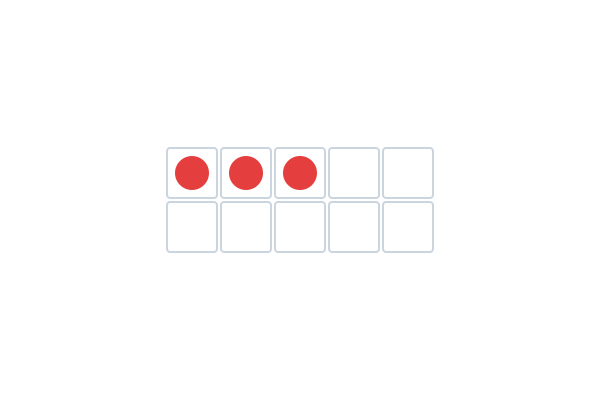
Count the dots and add 1 more. How many dots now?
- 3
- 4
- 5
Why this matters
Seeing that each next number is one more is your child's first step toward adding. It lets them answer "seven and one more" by saying eight, without recounting, and it leads to counting on in kindergarten and 1st grade: to find 8 + 3, start at 8 and count three more. Later it helps with number lines, where every step to the right is one bigger.
Where kids can get stuck
- Recounting the whole group from one after a single object is added, instead of saying the next number.
- Guessing that one more than five is seven, instead of moving to the very next number.
- Thinking that taking one away changes the total by a lot, and not yet knowing one less than four is three.
How you can help
- Drop pennies into a jar one at a time and say the new total each time, "that makes four, one more makes five," so the pattern of one more is heard.
- Build a tower of blocks together, asking before each new block "how many will there be with one more?" and then adding it to check.
- Count out crackers at snack time and hand over one extra, asking your child to tell you the new number without counting the whole pile again.
Want a little more? Watch the kid-friendly video below together, or try Bobby's Math Club for free practice that adapts to your child.
Kid-friendly explanation
Questions parents ask
Why is my child learning that each number is one more than the last?
This idea explains why counting works. When your child sees that four is three and one more, the numbers stop being a list of words and become a set of amounts that grow in a steady way. That understanding leads directly to adding one, counting on from a number, and later to adding larger amounts.
My child counts everything again when I add one more. Is that a problem?
No, it is a normal stage. Recounting from one is a safe strategy your child trusts. As they see the same pattern many times, they will start to notice that the answer is always the next number. You can help by pausing and asking "what number comes after five?" before they start recounting, and letting them check by counting.
How does this connect to adding?
Adding one is the same as moving to the next counting number, so this skill is a child's first experience of addition. Once your child knows that one more than 6 is 7, they are ready to count on: starting at 6 and counting "7, 8" to add two. That strategy is a key part of kindergarten math.
Make learning math fun
Bobby's Math Club turns Pre-K math practice into something fun to do together.
- Free, unlimited practice for every child in your family
- A few minutes a day, at just the right level
- You see their progress and what to work on next

Written by Robert “Bobby” Barnett
Bobby is an award-winning math teacher, the author of Meet Every Learner’s Needs, and the father of two elementary-school math learners. He uses Bobby’s Math Club with his own kids a few times every week. Learn more or contact Bobby.
Ready to watch your child’s confidence grow?
Your Pre-K child can start today with free, unlimited practice that grows with them.
Join the clubNote for teachers: This skill is covered by the Pre-K math learning standard PK.CC.3c: “Understand that each successive number name refers to a quantity that is one larger.” Learn how Bobby's Math Club can help your students grow. (Pre-K standard PK.CC.3c)