
Go Math! Grade 4, Chapter 14: Two-Dimensional Figures
In this unit, your child names and draws points, lines, line segments, rays, and angles, and finds parallel and perpendicular lines. They classify triangles by their angles and quadrilaterals by their sides and angles, find and draw lines of symmetry in shapes and letters, and describe and extend patterns made of shapes.

By Robert “Bobby” BarnettMath teacher, parent, and founder of Bobby’s Math Club
Sample questions to try together
These are real questions from our practice. Tap the speaker to hear one read aloud, or the light bulb for a hint, and talk about the answer together.
Question 1 of 3
Which of these shapes has exactly six line segments?
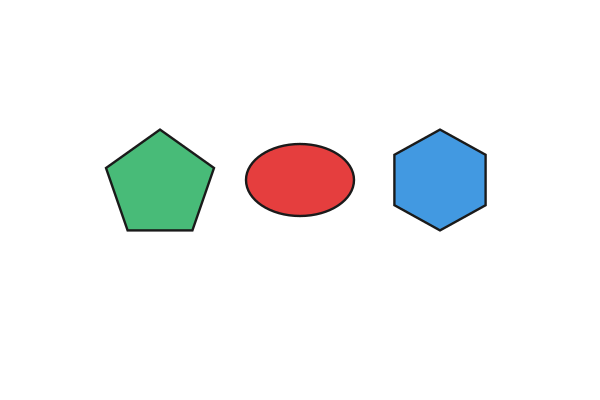
- Pentagon
- Hexagon
- Oval
What is my child learning in Chapter 14?
- Naming angles as right, acute, or obtuse by comparing them to a square corner, and drawing parallel and perpendicular lines. Learn more: Spotting lines, rays, angles, and parallel lines
- Classifying triangles by their angles, and quadrilaterals like trapezoids and parallelograms by their parallel and perpendicular sides. Learn more: Sorting shapes by their sides and angles
- Finding lines of symmetry in shapes and letters, and completing a picture so it matches on both sides of a line. Learn more: Finding lines of symmetry
- Finding the rule in a repeating shape pattern and using it to predict a later shape, like the 10th one. Learn more: Number patterns that follow a rule
How you can help
- Look at the clock hands together at 3:00, 2:00, and 5:00. Ask your child to name each angle as right, acute, or obtuse.
- Draw a triangle with a square corner, then turn the paper upside down. Ask your child whether it is still a right triangle, and check the corner with a piece of paper.
- Look for symmetry on a walk, in leaves, windows, and signs. Ask where the line of symmetry would be, and whether there could be more than one.
Where kids can get stuck
- Calling an angle obtuse because its rays are drawn long, instead of checking how wide it opens.
- Deciding a triangle isn't a right triangle because it's turned on its side.
- Drawing a diagonal on a long rectangle as a line of symmetry because it makes two equal pieces.
Practice makes perfect
Bobby's Math Club has practice problems that adapt to your child’s level, each with a detailed explanation and an easy-to-follow video, so your child can build confidence in these skills one step at a time.
Words your child will hear
- line segment
- A part of a line with two endpoints.
- ray
- A part of a line that starts at one point and goes on forever in one direction.
- right angle
- An angle that measures exactly 90 degrees, like the corner of a sheet of paper.
- acute angle
- An angle smaller than a right angle, measuring less than 90 degrees.
- obtuse angle
- An angle larger than a right angle but smaller than 180 degrees.
- parallel lines
- Lines that always stay the same distance apart and never meet.
- perpendicular lines
- Lines that meet or cross to make right angles.
- trapezoid
- A quadrilateral with at least one pair of parallel sides.
- line of symmetry
- A line that folds a shape into two halves that match exactly.
Want to help your child with two-dimensional shapes?
In Bobby's Math Club, your child practices two-dimensional shapes at just the right level, with a hint when they need one, a clear explanation after every question, and kid-friendly videos. Unlimited practice is free.
Join the clubCurious about your child’s level?
Take a free placement test →
Written by Robert “Bobby” Barnett
Bobby is an award-winning math teacher, the author of Meet Every Learner’s Needs, and the father of two elementary-school math learners. He uses Bobby’s Math Club with his own kids a few times every week. Learn more or contact Bobby.
Which math standards does Go Math! Grade 4 Chapter 14 cover?
Go Math! Grade 4 Chapter 14 covers these math standards. Each one links to what it means, sample questions, and teaching strategies.
For teachers: Unit names and order vary between editions and districts, so your school’s own materials have the exact sequence. Learn how Bobby's Math Club can help your students grow.