
Finding lines of symmetry
In 4th grade, children learn what a line of symmetry is, a line where a shape folds into two matching halves, and how to find and draw lines of symmetry on shapes.

By Robert “Bobby” BarnettMath teacher, parent, and founder of Bobby’s Math Club
Try these with your child
These are real questions from our 4th grade practice. Tap the speaker to hear one read aloud, or the light bulb for a hint, and talk about the answer together.
Question 1 of 3
Can this shape be folded straight across its middle, top half onto bottom half, so the two halves match?
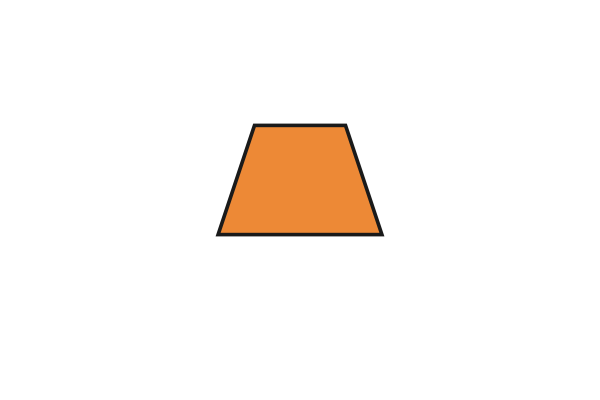
- No, its top side is shorter than its bottom side.
- Yes, because it has four sides.
- Yes, its top and bottom sides are parallel.
Why this matters
Symmetry trains your child to look closely and picture how a shape would fold or flip, which helps when they draw or read a map, and when they notice designs in art, buildings, and nature, like a butterfly's wings. In later grades, the same spatial thinking supports moving shapes by flipping, turning, and sliding them, and eventually the study of when two shapes are exactly the same size and shape.
Where kids can get stuck
- Drawing a rectangle's diagonal as a line of symmetry, because it makes two equal pieces, even though the halves do not match when folded.
- Stopping after one line of symmetry on a shape with several, such as the vertical line on a square.
- Missing a line of symmetry when a shape is tilted on the page, as if it must stand upright.
How you can help
- Fold paper shapes or napkins at the table. Ask your child to predict where the halves will match, then fold to check, trying both the middle and the diagonals of a square napkin.
- Look for symmetry on a walk, in leaves, butterflies, windows, or car fronts. Ask your child where the line of symmetry would be and whether there could be more than one.
- Write capital letters together and decide which ones have a line of symmetry. Letters such as A, M, and T have one; H and X have two; and letters such as F, G, and R have none.
Want a little more? Try Bobby's Math Club for free practice that adapts to your child.
Questions parents ask
Why is my child learning symmetry this way?
Folding a shape and checking whether the halves match exactly gives your child a clear, hands-on test for a line of symmetry. It helps them avoid assuming that any line cutting a shape in half is a line of symmetry. Finding and drawing these lines builds careful observation and spatial thinking, skills that also help with art, design, and reading diagrams.
Why isn't the diagonal of a rectangle a line of symmetry?
A diagonal cuts a rectangle into two triangles of the same size, so it seems like it should work. But if you fold a long rectangle along its diagonal, the corners stick out and the halves do not land on top of each other. So it is not a line of symmetry. A square is different: its diagonals are lines of symmetry. Folding paper is the best way to see this.
Can a shape have more than one line of symmetry, or none at all?
Yes to both. A heart has one line of symmetry, a rectangle has two, a square has four, and a circle has more than anyone could count, since any line through its center works. Some shapes, like the letter F or most irregular shapes, have no line of symmetry at all. Looking for every possible line, not only the first one, is part of this skill.
Make learning math fun
Bobby's Math Club turns 4th grade math practice into something fun to do together.
- Unlimited free practice
- Questions matched to your child’s level, a few minutes a day
- Hints when they are stuck, and a celebration when it clicks

Written by Robert “Bobby” Barnett
Bobby is an award-winning math teacher, the author of Meet Every Learner’s Needs, and the father of two elementary-school math learners. He uses Bobby’s Math Club with his own kids a few times every week. Learn more or contact Bobby.
Ready to watch your child’s confidence grow?
Your 4th grade child can start today with free, unlimited practice that grows with them.
Join the clubNote for teachers: This skill is covered by Common Core math standard 4.G.A.3: “Recognize a line of symmetry for a two-dimensional figure as a line across the figure such that the figure can be folded along the line into matching parts. Identify line-symmetric figures and draw lines of symmetry.” Learn how Bobby's Math Club can help your students grow. (Common Core 4.G.3)