
Adding angles together to find a missing one
In 4th grade, children learn that an angle split into parts that do not overlap equals the sum of those parts, and how to use this to find a missing angle.

By Robert “Bobby” BarnettMath teacher, parent, and founder of Bobby’s Math Club
Try these with your child
These are real questions from our 4th grade practice. Tap the speaker to hear one read aloud, or the light bulb for a hint, and talk about the answer together.
Question 1 of 3
A ray splits an angle into two parts. What does the whole angle measure?
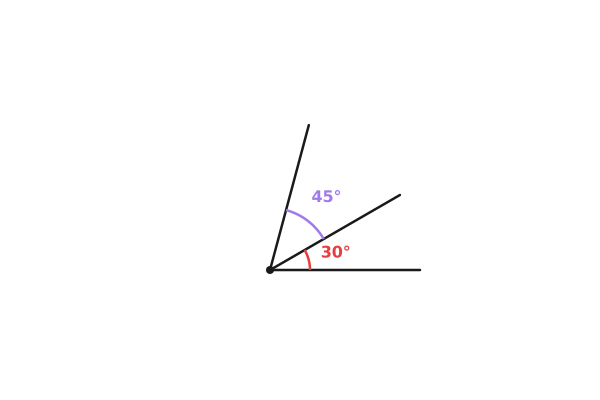
- 15°
- 75°
- 45°
Why this matters
Finding a missing angle is one of your child's first chances to solve for an unknown, by writing something like 35 + ? = 90, and that habit is a quiet step toward algebra. In middle school, the same reasoning is how they find missing angles inside triangles, around a point, and where two lines cross, and it shows up later in building and design.
Where kids can get stuck
- Adding the parts and then the whole angle too, giving 150 degrees for an angle made of 30 and 45 degrees.
- Subtracting from the wrong total, using 180 instead of 90 for a right angle, and answering 145 instead of 55.
- Measuring the diagram with a protractor instead of using the numbers given, and landing a few degrees off.
How you can help
- Fold a sheet of paper so one corner makes a 90-degree angle. Fold it again to split the corner into two parts, and ask your child to guess each part and check that they add to about 90.
- Cut a paper plate or pizza into slices of different sizes. Ask your child to put two slices side by side and talk about how the angle at the center of both together compares with each one.
- Use a clock face at bedtime. Ask your child how big the angle between the hands is at 3:00, then at 1:00, and how many 1:00-size angles fit inside the 3:00 one.
For more, Bobby's Math Club has free practice at your child’s level.
Questions parents ask
Why is my child learning to add angles this way?
Seeing that two angles side by side make a larger angle equal to their sum connects geometry to the addition and subtraction your child already knows. It also explains how a protractor works, since it counts degrees from one ray to the other. Writing an equation such as 35 + ? = 90 to find a missing angle gives your child practice with unknowns, an important step toward algebra.
How does my child find a missing angle?
They start with the total and subtract the angle they know. If a right angle, which is 90 degrees, is split into two parts and one part is 40 degrees, the missing part is 90 − 40 = 50 degrees. If the angles together make a half turn, the total is 180 degrees. Writing an equation with a box or letter for the unknown helps your child keep track.
Does my child need a protractor for these problems?
Usually not. Most of these problems give the angle measures as numbers, and your child adds or subtracts to find the answer. The drawing shows how the angles fit together, but it may not be drawn exactly to scale. Teachers want your child to reason from the numbers. A protractor can be useful afterward as a check, but the exact answer comes from the arithmetic.
Make learning math fun
Bobby's Math Club turns 4th grade math practice into something fun to do together.
- Unlimited practice, completely free
- Questions matched to your child’s level, a few minutes a day
- Level-ups, badges, and a cheer for every win

Written by Robert “Bobby” Barnett
Bobby is an award-winning math teacher, the author of Meet Every Learner’s Needs, and the father of two elementary-school math learners. He uses Bobby’s Math Club with his own kids a few times every week. Learn more or contact Bobby.
Ready to watch your child’s confidence grow?
Your 4th grade child can start today with free, unlimited practice that grows with them.
Join the clubNote for teachers: This skill is covered by Common Core math standard 4.MD.C.7: “Recognize angle measure as additive. When an angle is decomposed into non-overlapping parts, the angle measure of the whole is the sum of the angle measures of the parts. Solve addition and subtraction problems to find unknown angles on a diagram in real world and mathematical problems, e.g., by using an equation with a symbol for the unknown angle measure.” Learn how Bobby's Math Club can help your students grow. (Common Core 4.MD.7)