
Writing fractions as decimals, like 0.62
In 4th grade, children learn to write fractions with denominators of 10 or 100 as decimals, such as 4/10 = 0.4 and 62/100 = 0.62.

By Robert “Bobby” BarnettMath teacher, parent, and founder of Bobby’s Math Club
Try these with your child
These are real questions from our 4th grade practice. Tap the speaker to hear one read aloud, or the light bulb for a hint, and talk about the answer together.
Question 1 of 3
Point P is on a number line from 0 to 1. What decimal does point P show?
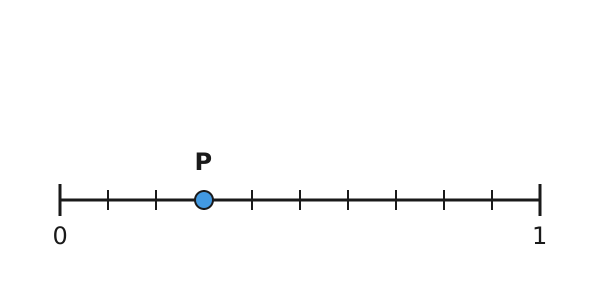
- 0.3
- 0.03
- 0.7
Why this matters
Decimals are already in your child's world: prices, race times, a height in meters, the readout on a kitchen scale. Seeing them as fractions written a new way keeps them from feeling like a separate topic. In 5th grade, your child extends decimals to thousandths and begins adding, subtracting, multiplying, and dividing them, and in middle school decimals connect to percents.
Where kids can get stuck
- Writing 7/100 as 0.7, leaving out the zero in the tenths place, which makes it ten times too big.
- Reading 0.62 as "point sixty-two" without knowing it means sixty-two hundredths.
- Thinking 0.50 is more than 0.5 because it has more digits, rather than seeing both as five tenths.
How you can help
- Read prices together and say them as fractions of a dollar. For $0.35, ask your child to say "thirty-five hundredths" and to name the coins, such as 3 dimes and 1 nickel.
- Use a kitchen scale or a bathroom scale that shows tenths. Ask your child to read a number like 2.3 and say it as "two and three tenths."
- Look at race times or rainfall amounts in the news, such as 0.08 inches of rain. Ask your child to say it as a fraction and decide whether it is more or less than one tenth.
If it’s helpful, you can sign up for free, adaptive practice in Bobby's Math Club.
Questions parents ask
Why is my child learning decimals as fractions first?
Starting with fractions gives decimals a meaning your child already understands. If your child knows that 4/10 means four tenths, then 0.4 is a new way to write something familiar. Without that link, decimals can feel like whole numbers with a dot in them, which leads to mistakes such as thinking 0.25 is bigger than 0.3. The fraction connection prevents many of those errors.
How far does my child go with decimals in 4th grade?
In 4th grade, decimals stop at hundredths, the second place after the decimal point. Your child writes them, reads them, places them on a number line, and compares them. Adding and subtracting decimals in written form, and working with thousandths, come in 5th grade. Money is a good everyday link, since prices also stop at hundredths of a dollar.
Why is there a zero in 0.07?
The zero holds the tenths place. In 0.07, there are 0 tenths and 7 hundredths, which equals 7/100. Without the zero, 0.7 would mean 7 tenths, or 70/100, which is ten times as much. This works the same way as zeros in whole numbers: in 307, the zero shows there are no tens. Coins make it clear: 7 pennies is $0.07, not $0.70.
Make learning math fun
Bobby's Math Club turns 4th grade math practice into something fun to do together.
- Free, unlimited practice for every child in your family
- Practice that starts where your child is and grows with them
- Level-ups, badges, and a cheer for every win

Written by Robert “Bobby” Barnett
Bobby is an award-winning math teacher, the author of Meet Every Learner’s Needs, and the father of two elementary-school math learners. He uses Bobby’s Math Club with his own kids a few times every week. Learn more or contact Bobby.
Ready to watch your child’s confidence grow?
Your 4th grade child can start today with free, unlimited practice that grows with them.
Join the clubNote for teachers: This skill is covered by Common Core math standard 4.NF.C.6: “Use decimal notation for fractions with denominators 10 or 100. For example, rewrite 0.62 as 62/100; describe a length as 0.62 meters; locate 0.62 on a number line diagram.” Learn how Bobby's Math Club can help your students grow. (Common Core 4.NF.6)