
Go Math! Kindergarten, Chapter 20: Data
In this unit, the year closes with sorting. Your child sorts objects by shape and size, then into three or more groups, counts how many are in each group, and orders the groups by their counts. It draws on the measuring words from the last unit, since size is one way to sort, and it rounds off kindergarten by putting counting to work organizing the world around them.

By Robert “Bobby” BarnettMath teacher, parent, and founder of Bobby’s Math Club
Sample questions to try together
These are real questions from our practice. Tap the speaker to hear one read aloud, or the light bulb for a hint, and talk about the answer together.
Question 1 of 3
Look at the chart. How many dogs are there?
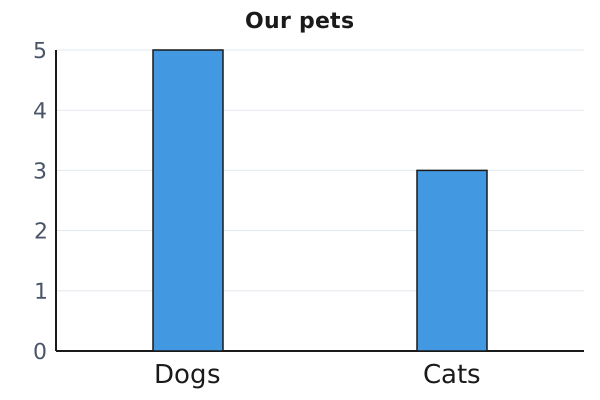
- 5
- 8
- 3
What is my child learning in Chapter 20?
- Sorting objects into groups by shape, size, or another rule, counting each group, and ordering the groups by how many. Learn more: Sorting things into groups and counting them
How you can help
- Mix a handful of clean forks and spoons, sort them into two groups, count each group, and ask your child which group has more and which has fewer.
- Gather stuffed animals, shoes, or large toys and let your child choose a rule for sorting, such as color or size, then count each group and line them up from most to fewest.
- Sort the family's shoes by the door into groups, such as sneakers, boots, and sandals, and count each group together.
Where kids can get stuck
- Ordering groups by the space they take up, so 4 big boots seem like more than 7 small sneakers.
- Changing the sorting rule partway, putting some toys by color and others by size.
- Lining the groups up from fewest to most when the question asked for most to fewest.
Practice makes perfect
Bobby's Math Club has practice problems that adapt to your child’s level, each with a detailed explanation and an easy-to-follow video, so your child can build confidence in these skills one step at a time.
Words your child will hear
- sort
- To put things into groups that belong together.
- classify
- To sort things into groups by what they have in common.
- group
- A set of things that belong together in some way.
- category
- A group with a rule, like all the red things.
- most
- The group with the largest number of things.
- fewest
- The group with the smallest number of things.
- count
- To say numbers in order, giving one number to each thing.
Ready to build your child’s confidence with sorting and counting groups?
In Bobby's Math Club, your child practices sorting and counting groups at just the right level, with a hint when they need one, a clear explanation after every question, and kid-friendly videos. Unlimited practice is free.
Join the clubCurious about your child’s level?
Take a free placement test →
Written by Robert “Bobby” Barnett
Bobby is an award-winning math teacher, the author of Meet Every Learner’s Needs, and the father of two elementary-school math learners. He uses Bobby’s Math Club with his own kids a few times every week. Learn more or contact Bobby.
Which math standards does Go Math! Kindergarten Chapter 20 cover?
Go Math! Kindergarten Chapter 20 covers this math standard. Each one links to what it means, sample questions, and teaching strategies.
- K.MD.B.3: Classify objects into categories.
For teachers: Unit names and order vary between editions and districts, so your school’s own materials have the exact sequence. Learn how Bobby's Math Club can help your students grow.