
Adding two-digit numbers within 100
In 1st grade, children learn to add within 100 by combining tens with tens and ones with ones, to make a new ten when needed, and to explain their method.

By Robert “Bobby” BarnettMath teacher, parent, and founder of Bobby’s Math Club
Try these with your child
These are real questions from our 1st grade practice. Tap the speaker to hear one read aloud, or the light bulb for a hint, and talk about the answer together.
Question 1 of 3
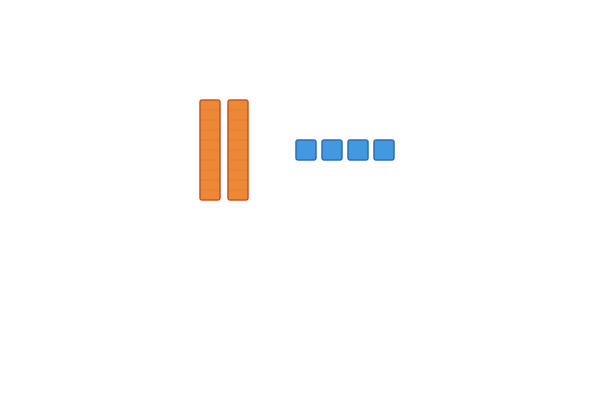
If you have 2 tens and 4 ones, and then you get 5 more ones, how many do you have in total?
- 30
- 29
- 28
Why this matters
Watching tens join tens and ones join ones helps your child see what really happens when numbers are added, and that is the thinking behind every written method for larger numbers. A child who understands why 36 + 7 makes a new ten will find adding two-digit numbers in 2nd grade, and three-digit numbers soon after, sensible rather than mysterious. It also makes everyday sums, like adding up two prices, possible in their head.
Where kids can get stuck
- Lining the 7 up under the 3 in 36 + 7, adding it to the tens, and getting 106 instead of 43.
- Writing down all 13 ones instead of making a new ten, so 36 + 7 becomes 313 or 3013.
- Treating 36 + 20 like 36 + 2 and answering 38, because the zero in 20 seems unimportant.
How you can help
- Use dimes and pennies to add. Make 36 cents with 3 dimes and 6 pennies, add 7 more pennies, then trade 10 pennies for a dime and count the total of 43 cents.
- Add tens while walking or driving: "We have gone 25 steps. If we take 10 more, then 10 more, where will we be?" Encourage counting by tens from 25.
- Ask your child to explain their thinking for one problem a day, such as 48 + 6, in their own words. Listening to their reasoning matters more than the answer.
The kid-friendly video below is a nice one to watch together. For more, Bobby's Math Club has free practice at your child’s level.
Kid-friendly explanation
Questions parents ask
Why is my child adding with blocks and drawings instead of a written method?
Blocks and drawings show what happens when tens and ones are combined, including when 10 ones become a new ten. Children who understand this can later use written methods correctly and catch their own mistakes. Learning the shortcut first often leads to steps done in the wrong place without knowing why.
What does it mean to compose a ten?
To compose a ten means to group 10 ones into 1 ten. For example, in 47 + 5, the 7 ones and 5 ones make 12 ones, which is 1 ten and 2 ones. That new ten joins the 4 tens to make 5 tens, so the answer is 52. In older terms, this is sometimes called carrying.
Should my child add two two-digit numbers like 34 + 27 in 1st grade?
In 1st grade, the focus is on adding a two-digit number and a one-digit number, or a two-digit number and a multiple of ten, like 34 + 20. Adding two general two-digit numbers is a main goal of 2nd grade. If your child is curious, the same tens-with-tens and ones-with-ones thinking works.
Make learning math fun
Bobby's Math Club turns 1st grade math practice into something fun to do together.
- Unlimited free practice
- A few minutes a day, at just the right level
- Hints when they are stuck, and a celebration when it clicks

Written by Robert “Bobby” Barnett
Bobby is an award-winning math teacher, the author of Meet Every Learner’s Needs, and the father of two elementary-school math learners. He uses Bobby’s Math Club with his own kids a few times every week. Learn more or contact Bobby.
Ready to watch your child’s confidence grow?
Your 1st grade child can start today with free, unlimited practice that grows with them.
Join the clubNote for teachers: This skill is covered by Common Core math standard 1.NBT.C.4: “Add within 100, including adding a two-digit number and a one-digit number, and adding a two-digit number and a multiple of 10, using concrete models or drawings and strategies based on place value, properties of operations, and/or the relationship between addition and subtraction; relate the strategy to a written method and explain the reasoning used. Understand that in adding two-digit numbers, one adds tens and tens, ones and ones; and sometimes it is necessary to compose a ten.” Learn how Bobby's Math Club can help your students grow. (Common Core 1.NBT.4)