
Telling time to the hour and half hour
In 1st grade, children learn to tell and write time to the hour and half hour on both analog and digital clocks.

By Robert “Bobby” BarnettMath teacher, parent, and founder of Bobby’s Math Club
Try these with your child
These are real questions from our 1st grade practice. Tap the speaker to hear one read aloud, or the light bulb for a hint, and talk about the answer together.
Question 1 of 3
What time does the clock show?
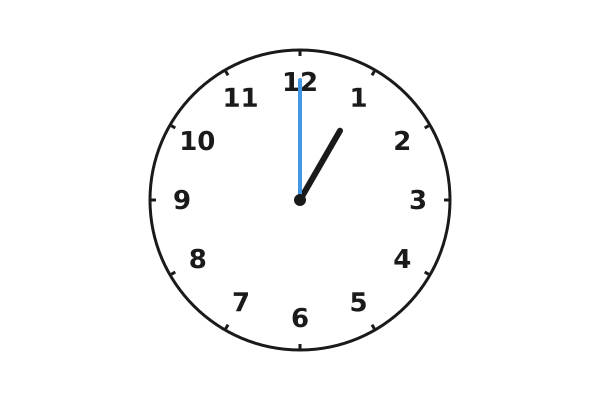
- 12:00
- 2:00
- 1:00
Why this matters
Reading a clock helps your child understand the shape of their day, from when school starts to how long until bedtime. In 2nd grade they read time to the nearest five minutes and learn a.m. and p.m., and in 3rd grade they work out how much time has passed, like how long a practice from 3:00 to 3:45 lasts.
Where kids can get stuck
- Mixing up the two hands, reading 6:00 as 12:30 by taking the long hand for the hour.
- Reading 4:30 as 5:30 because the short hand is close to the 5, not knowing it stays between the numbers until the next hour.
- Writing half past seven as 7:50 or 7:3, unsure how the half hour looks on a digital clock.
How you can help
- Point out the time at routine moments, like "It is 7:30, time for bed," and look at an analog clock together. Ask where the short hand and the long hand are pointing.
- Make a paper plate clock with two paper hands and a brass fastener. Call out times like 2:00 or 9:30 and let your child set the hands, then check against a real clock.
- Compare an analog clock and a digital clock, such as on the oven, at the same moment and talk about how both show the same time in different ways.
The kid-friendly video below is a nice one to watch together. For more, Bobby's Math Club has free practice at your child’s level.
Kid-friendly explanation
Questions parents ask
Why is my child learning to tell time on an analog clock?
Analog clocks show time as movement around a circle, which helps children understand how time passes and connects to ideas like half of a whole. They also still appear in schools, homes, and public places. Learning both analog and digital clocks lets your child read time wherever they see it.
My child can read 3:00 but not 3:30. What helps?
Half hours are harder because the short hand is between two numbers. Show your child that when the long hand points at 6, it has gone halfway around, so it is half past the hour. Point out that the short hand has moved halfway to the next number. Watching a real clock move from 3:00 to 3:30 also helps.
When will my child learn to tell time to the minute?
In 1st grade, the goal is hours and half hours. In 2nd grade, children learn to read clocks to the nearest five minutes and use a.m. and p.m. Telling time to the exact minute comes in 3rd grade, along with finding how much time has passed between two times.
Make learning math fun
Bobby's Math Club turns 1st grade math practice into something fun to do together.
- Free, unlimited practice for every child in your family
- A few minutes a day, at just the right level
- You see their progress and what to work on next

Written by Robert “Bobby” Barnett
Bobby is an award-winning math teacher, the author of Meet Every Learner’s Needs, and the father of two elementary-school math learners. He uses Bobby’s Math Club with his own kids a few times every week. Learn more or contact Bobby.
Ready to watch your child’s confidence grow?
Your 1st grade child can start today with free, unlimited practice that grows with them.
Join the clubNote for teachers: This skill is covered by Common Core math standard 1.MD.B.3: “Tell and write time in hours and half-hours using analog and digital clocks.” Learn how Bobby's Math Club can help your students grow. (Common Core 1.MD.3)