
Sorting, tallying, and reading simple charts
In 1st grade, children learn to sort information into up to three groups, to show it in a simple chart or tally, and to answer questions about totals and which group has more or fewer.

By Robert “Bobby” BarnettMath teacher, parent, and founder of Bobby’s Math Club
Try these with your child
These are real questions from our 1st grade practice. Tap the speaker to hear one read aloud, or the light bulb for a hint, and talk about the answer together.
Question 1 of 3
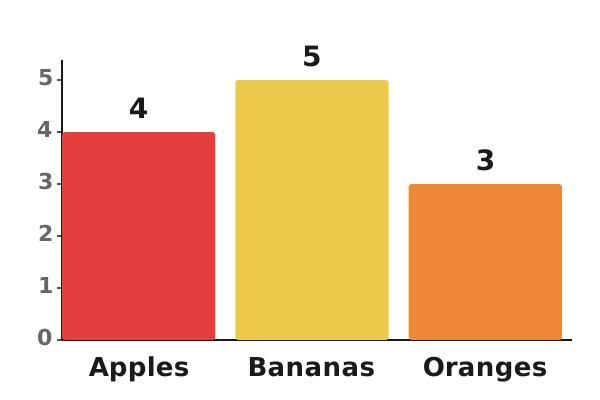
The bar graph shows students' favorite fruits. How many students chose bananas as their favorite fruit?
- 4
- 3
- 5
Why this matters
Charts and tallies show your child that numbers can answer real questions, like which snack the family likes best, a habit they will need in every grade and in daily life. In 2nd grade they make picture graphs and bar graphs with up to four groups, and in 3rd grade those graphs use scales where one picture stands for several things. Questions like "how many more" also give extra practice with subtraction.
Where kids can get stuck
- Answering only for the biggest group when asked how many there are altogether, instead of adding all three groups.
- Naming the apple total, 6, for "How many more chose apples than grapes?" instead of finding the difference, 3.
- Losing or double counting items while sorting, so the group totals no longer add up to the whole collection.
How you can help
- Sort laundry, toys, or snacks into three groups, such as socks, shirts, and pants. Count each group, then ask how many items there are in all and which group has the most.
- Take a family vote on dinner or a movie with three choices. Make tally marks together, then ask how many more votes the winner got than the others.
- Count cars by color on a short walk using three colors, such as white, black, and red, and talk about what the tally tells you.
The kid-friendly video below explains it in a few minutes, and Bobby's Math Club offers free practice that grows with your child.
Kid-friendly explanation
Questions parents ask
Why is my child learning about charts and data in 1st grade?
Sorting and counting information helps your child practice adding and comparing in a meaningful way. Questions like "How many more?" connect to word problems, and reading a chart builds early skills for understanding information. These are the first steps toward the graphs your child will make and interpret in later grades.
What kinds of questions should my child answer about data?
In 1st grade, children answer three main kinds of questions: how many in one category, how many in all, and how many more or fewer in one category than another. For example, with 5 cats, 3 dogs, and 2 fish, they find 10 pets in all and 2 more cats than dogs.
Why are there only three categories?
Three categories keep the numbers manageable and let children focus on organizing and comparing without being overwhelmed. With three groups, a child can add all the totals and compare any two groups using numbers within 20. In 2nd grade, they move to four categories and to picture graphs and bar graphs.
Make learning math fun
Bobby's Math Club turns 1st grade math practice into something fun to do together.
- Unlimited practice, completely free
- Practice that starts where your child is and grows with them
- You see their progress and what to work on next

Written by Robert “Bobby” Barnett
Bobby is an award-winning math teacher, the author of Meet Every Learner’s Needs, and the father of two elementary-school math learners. He uses Bobby’s Math Club with his own kids a few times every week. Learn more or contact Bobby.
Ready to watch your child’s confidence grow?
Your 1st grade child can start today with free, unlimited practice that grows with them.
Join the clubNote for teachers: This skill is covered by Common Core math standard 1.MD.C.4: “Organize, represent, and interpret data with up to three categories; ask and answer questions about the total number of data points, how many in each category, and how many more or less are in one category than in another.” Learn how Bobby's Math Club can help your students grow. (Common Core 1.MD.4)