
Naming triangles, hexagons, cubes, and more
In 2nd grade, children learn to recognize and draw shapes by their features, such as how many angles or faces they have; and to name triangles, quadrilaterals, pentagons, hexagons, and cubes.

By Robert “Bobby” BarnettMath teacher, parent, and founder of Bobby’s Math Club
Try these with your child
These are real questions from our 2nd grade practice. Tap the speaker to hear one read aloud, or the light bulb for a hint, and talk about the answer together.
Question 1 of 3
Which of these shapes has exactly three angles?
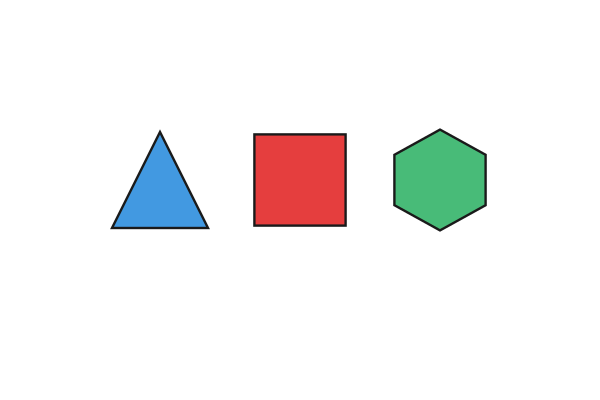
- Hexagon
- Triangle
- Square
Why this matters
Naming shapes by their features gives your child the words to describe the world around them and a habit of looking closely. Counting sides, corners, and faces teaches them to reason about a shape rather than judge its look, so a lopsided six-sided shape is still a hexagon. That careful attention leads to 3rd grade, when children sort four-sided shapes into families like rectangles and squares, and to measuring angles in 4th grade.
Where kids can get stuck
- Recognizing only regular shapes, so refusing to call an uneven six-sided shape a hexagon.
- Thinking a quadrilateral must be a square or rectangle, and leaving out kites and slanted four-sided shapes.
- Losing count of sides or angles by starting and stopping at different corners and counting one twice.
How you can help
- Go on a shape hunt around the house or neighborhood, finding examples of triangles, quadrilaterals, pentagons, and hexagons, and count the sides of each one together.
- Draw a shape for your child to name, such as a lopsided five-sided shape, and ask them how they know what it is by counting sides and angles.
- Look closely at a box shaped like a cube, such as a tissue box or a die, and count its faces together, checking that all six faces are the same size square.
The kid-friendly video below explains it in a few minutes, and Bobby's Math Club offers free practice that grows with your child.
Kid-friendly explanation
Questions parents ask
Why is my child learning to identify shapes by sides and angles?
Counting sides and angles teaches your child to recognize shapes by what defines them, not by how they usually look. A hexagon is any closed shape with 6 straight sides and 6 angles, even if it is uneven. This reasoning prepares your child for sorting and classifying shapes in later grades.
What is a quadrilateral?
A quadrilateral is any closed shape with 4 straight sides and 4 angles. Squares, rectangles, and trapezoids are all quadrilaterals, and so are many irregular four-sided shapes. In 3rd grade, children learn to sort quadrilaterals into smaller groups, such as squares and rhombuses.
What is an angle for a 2nd grader?
In 2nd grade, an angle is the corner where two sides of a shape meet. Children count angles to identify shapes, such as a pentagon having 5 angles. Measuring how wide an angle is, using degrees, does not come until 4th grade.
Make learning math fun
Bobby's Math Club turns 2nd grade math practice into something fun to do together.
- Unlimited practice, completely free
- Practice that starts where your child is and grows with them
- Level-ups, badges, and a cheer for every win

Written by Robert “Bobby” Barnett
Bobby is an award-winning math teacher, the author of Meet Every Learner’s Needs, and the father of two elementary-school math learners. He uses Bobby’s Math Club with his own kids a few times every week. Learn more or contact Bobby.
Ready to watch your child’s confidence grow?
Your 2nd grade child can start today with free, unlimited practice that grows with them.
Join the clubNote for teachers: This skill is covered by Common Core math standard 2.G.A.1: “Recognize and draw shapes having specified attributes, such as a given number of angles or a given number of equal faces. Identify triangles, quadrilaterals, pentagons, hexagons, and cubes.” Learn how Bobby's Math Club can help your students grow. (Common Core 2.G.1)