
Splitting a rectangle into rows of squares
In 2nd grade, children learn to divide a rectangle into rows and columns of equal squares and to count them.

By Robert “Bobby” BarnettMath teacher, parent, and founder of Bobby’s Math Club
Try these with your child
These are real questions from our 2nd grade practice. Tap the speaker to hear one read aloud, or the light bulb for a hint, and talk about the answer together.
Question 1 of 3
How many squares are in each row of this rectangle?
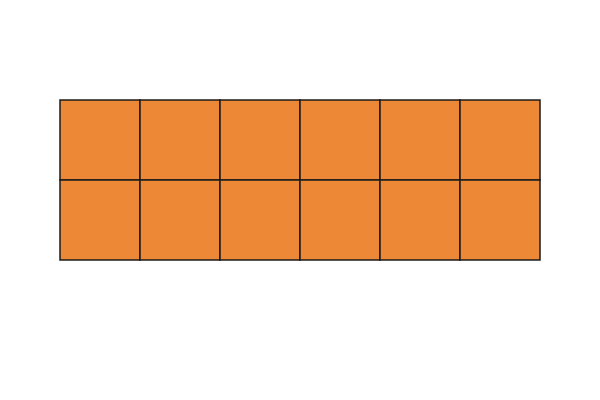
- 12
- 6
- 2
Why this matters
Drawing rows of equal squares sets your child up for two big ideas in 3rd grade. Covering a rectangle with squares is how area is measured, and the same rows and columns form an array, the picture behind multiplication, so 3 rows of 4 squares shows 3 × 4 = 12. Drawing equal rows is harder than it looks and builds careful spatial reasoning along the way.
Where kids can get stuck
- Drawing squares of different sizes, or rows with different numbers of squares, so the grid is not truly equal.
- Leaving gaps or overlaps when covering a rectangle with tiles, then counting as if it were covered exactly.
- Counting squares in no particular order, skipping some and counting others twice, instead of going row by row.
How you can help
- Cut a sandwich, brownie pan, or sheet of crackers into rows and columns of equal squares, and ask your child how many pieces there are and how they counted.
- Cover a book or a small box lid with square sticky notes, crackers, or tiles, with no gaps or overlaps, and count the squares by rows.
- Fold a sheet of paper in half and in half again in both directions, then unfold it and count the equal squares or rectangles formed by the creases.
Want a little more? Watch the kid-friendly video below together, or try Bobby's Math Club for free practice that adapts to your child.
Kid-friendly explanation
Questions parents ask
Why is my child dividing rectangles into squares?
Splitting a rectangle into equal squares and counting them is the foundation for understanding area, which is measured in square units. The rows and columns also form an array, which prepares your child for multiplication. Both are major topics in 3rd grade.
Is this the same as learning area?
It is the first step. In 2nd grade, children divide rectangles into equal squares and count them. In 3rd grade, they call the count the area, measured in square units, and learn that multiplying the number of rows by the number of squares in each row gives the area.
Why is drawing equal squares so hard for my child?
Drawing rows and columns that line up evenly takes planning and careful spatial thinking, and many 2nd graders find it tricky. Using graph paper, folding paper, or covering shapes with real square objects helps. The goal is understanding equal squares, not perfect drawing.
Make learning math fun
Bobby's Math Club turns 2nd grade math practice into something fun to do together.
- Free, unlimited practice for every child in your family
- Questions matched to your child’s level, a few minutes a day
- Hints when they are stuck, and a celebration when it clicks

Written by Robert “Bobby” Barnett
Bobby is an award-winning math teacher, the author of Meet Every Learner’s Needs, and the father of two elementary-school math learners. He uses Bobby’s Math Club with his own kids a few times every week. Learn more or contact Bobby.
Ready to watch your child’s confidence grow?
Your 2nd grade child can start today with free, unlimited practice that grows with them.
Join the clubNote for teachers: This skill is covered by Common Core math standard 2.G.A.2: “Partition a rectangle into rows and columns of same-size squares and count to find the total number of them.” Learn how Bobby's Math Club can help your students grow. (Common Core 2.G.2)