
Eureka Math² Grade 2, Module 1: Place Value Concepts Through Metric Measurement and Data • Place Value, Counting, and Comparing Within 1,000
In this unit, your child starts the year with graphs and centimeters, then numbers up to 1,000. They draw picture graphs and bar graphs, measure in centimeters and meters, and use a measuring tape like a number line to add and subtract lengths. Then they bundle ones, tens, and hundreds, write three-digit numbers in different forms, and compare them with >, =, and <. Adding and subtracting within 200 comes next.

By Robert “Bobby” BarnettMath teacher, parent, and founder of Bobby’s Math Club
Sample questions to try together
These are real questions from our practice. Tap the speaker to hear one read aloud, or the light bulb for a hint, and talk about the answer together.
Question 1 of 3
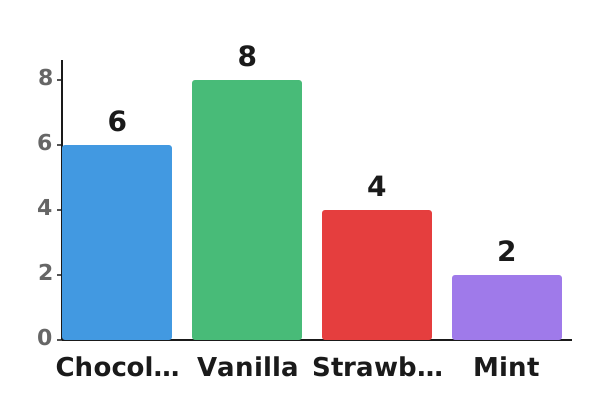
Look at the bar graph. Which ice cream flavor is the least popular?
- Mint
- Chocolate
- Vanilla
What is my child learning in Module 1?
- Drawing picture graphs and bar graphs and using them to solve put-together, take-apart, and compare problems. Learn more: Making and reading picture graphs and bar graphs
- Measuring length in centimeters and meters with a ruler, a meter stick, or a measuring tape. Learn more: Measuring with a ruler, yardstick, or tape
- Measuring two objects to find how much longer one is, such as 45 centimeters compared with 30 centimeters, a difference of 15. Learn more: Measuring how much longer one thing is
- Using a measuring tape like a number line to add and subtract lengths, jumping forward or back by tens and ones. Learn more: Adding and subtracting on a number line
- Seeing a three-digit number as hundreds, tens, and ones, so 362 is 3 hundreds, 6 tens, and 2 ones, and 10 tens make 1 hundred. Learn more: Hundreds, tens, and ones in numbers like 706
- Counting within 1,000 by ones, tens, and hundreds, including counting play money in $1, $10, and $100 bills. Learn more about counting within 1,000 · Learn more about skip-counting by 5s, 10s, and 100s
- Reading and writing numbers to 1,000 as numerals, in words, in unit form, and in expanded form, like 400 + 60 + 2. Learn more: Reading and writing numbers to 1,000
- Comparing three-digit numbers by their hundreds, tens, and ones and writing the result with >, =, or <. Learn more: Comparing three-digit numbers with >, =, and <
How you can help
- Ask everyone at home to vote on a favorite fruit, then draw a bar graph together. Ask how many more votes the top fruit got than the bottom one.
- Measure a few things with a measuring tape in centimeters, like a pillow and a towel, and ask how much longer one is than the other.
- Write a three-digit number on a sticky note, like 507, and ask your child to show it as hundreds, tens, and ones, then name a number that's greater.
Where kids can get stuck
- Starting a measurement at the end of the ruler instead of at the 0 mark, so the length comes out wrong.
- Writing five hundred seven as 5007, putting 500 and 7 side by side.
- Comparing 289 and 312 by looking at the ones first and calling 289 greater.
Practice makes perfect
Bobby's Math Club has practice problems that adapt to your child’s level, each with a detailed explanation and an easy-to-follow video, so your child can build confidence in these skills one step at a time.
Words your child will hear
- picture graph
- A chart that uses pictures to show how many are in each group.
- bar graph
- A chart that uses bars of different lengths to show and compare amounts.
- centimeter
- A small metric unit of length, about the width of your child's pinky fingernail.
- meter
- A metric unit of length equal to 100 centimeters.
- hundreds
- Groups of 100. In 706, the 7 means 7 hundreds, or 700.
- unit form
- Naming a number by its units, like 3 hundreds 4 tens 5 ones for 345.
- expanded form
- A number written as the sum of its parts, like 300 + 40 + 5 for 345.
- greater than
- The symbol > means the first number is bigger, like 512 > 498.
Ready to build your child’s confidence with graphs, measuring, and numbers to 1,000?
In Bobby's Math Club, your child practices graphs, measuring, and numbers to 1,000 at just the right level, with a hint when they need one, a clear explanation after every question, and kid-friendly videos. Unlimited practice is free.
Join the clubCurious about your child’s level?
Take a free placement test →
Written by Robert “Bobby” Barnett
Bobby is an award-winning math teacher, the author of Meet Every Learner’s Needs, and the father of two elementary-school math learners. He uses Bobby’s Math Club with his own kids a few times every week. Learn more or contact Bobby.
Which math standards does Eureka Math² Grade 2 Module 1 cover?
Eureka Math² Grade 2 Module 1 covers these math standards. Each one links to what it means, sample questions, and teaching strategies.
- 2.MD.D.10: Draw a picture graph and a bar graph to represent a data set with up to four categories.
- 2.MD.A.1: Measure the length of an object by selecting and using appropriate tools.
- 2.MD.A.4: Measure to determine how much longer one object is than another.
- 2.MD.B.6: Represent whole numbers as lengths from 0 on a number line diagram.
- 2.NBT.A.1: Understand that the three digits of a three-digit number represent amounts of hundreds, tens, and ones.
- 2.NBT.A.2: Count up to 1,000, and count by 5s, 10s, and 100s, like 5, 10, 15.
- 2.NBT.A.3: Read and write numbers to 1,000 as digits, words, and 300 + 40 + 5.
- 2.NBT.A.4: Compare two three-digit numbers.
For teachers: Unit names and order vary between editions and districts, so your school’s own materials have the exact sequence. Learn how Bobby's Math Club can help your students grow.