
Everyday Mathematics Kindergarten, Section 2: Naming and Describing Shapes; Counting
In this unit, your child takes a close look at triangles, circles, and rectangles, and learns that a shape keeps its name when it is turned or a different size. They keep counting groups set out in different ways, use ten frames, a box of two rows of five spaces, and act out short number stories. It builds on the first counting work and leads into reading and writing numbers.

By Robert “Bobby” BarnettMath teacher, parent, and founder of Bobby’s Math Club
Sample questions to try together
These are real questions from our practice. Tap the speaker to hear one read aloud, or the light bulb for a hint, and talk about the answer together.
Question 1 of 3
How many apples do you see?
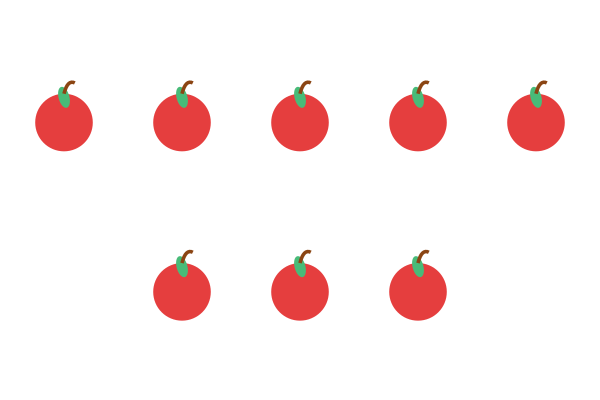
- 9
- 7
- 8
What is my child learning in Section 2?
- Counting groups of objects in lines, circles, and scattered piles, and showing numbers on a ten frame. Learn more: Counting groups of up to 20 things
- Solving short number stories by acting them out or using fingers, objects, and drawings, like 3 red apples and 2 green apples. Learn more: Adding and subtracting story problems within 10
- Naming triangles, circles, rectangles, and squares of any size or position. Learn more: Naming shapes turned any which way
- Describing shapes by their sides and corners, such as a triangle having 3 sides and 3 corners. Learn more: Comparing shapes by their sides and corners
How you can help
- Go on a shape hunt at home and point out triangles, circles, and rectangles, like a plate, a door, or a window. Ask how your child knows which shape it is.
- Tell a number story with stuffed animals: "There are 3 on the bed and 2 more jump on. How many now?" Let your child act it out and count.
- Show 4 fingers in different ways, like 2 on each hand or 4 on one hand. Ask your child to count each way and say how many.
Where kids can get stuck
- Saying a triangle is not a triangle when it is upside down or long and thin.
- Thinking a triangle stops being a triangle when it is turned so its point faces down.
- Losing track when counting a scattered pile, counting some objects twice and missing others.
Practice makes perfect
Bobby's Math Club has practice problems that adapt to your child’s level, each with a detailed explanation and an easy-to-follow video, so your child can build confidence in these skills one step at a time.
Words your child will hear
- triangle
- A flat shape with 3 straight sides and 3 corners.
- circle
- A flat, round shape with no corners.
- rectangle
- A flat shape with 4 straight sides and 4 square corners.
- square
- A flat shape with 4 straight sides that are all the same length and 4 square corners.
- side
- A straight line that makes up part of a shape's edge.
- corner
- The point where two sides of a shape meet.
- ten frame
- A box with two rows of five spaces, used to show numbers up to 10.
- number story
- A short story that ends with a math question.
Ready to build your child’s confidence with shapes and counting?
In Bobby's Math Club, your child practices shapes and counting at just the right level, with a hint when they need one, a clear explanation after every question, and kid-friendly videos. Unlimited practice is free.
Join the clubCurious about your child’s level?
Take a free placement test →
Written by Robert “Bobby” Barnett
Bobby is an award-winning math teacher, the author of Meet Every Learner’s Needs, and the father of two elementary-school math learners. He uses Bobby’s Math Club with his own kids a few times every week. Learn more or contact Bobby.
Which math standards does Everyday Mathematics Kindergarten Section 2 cover?
Everyday Mathematics Kindergarten Section 2 covers these math standards. Each one links to what it means, sample questions, and teaching strategies.
For teachers: Unit names and order vary between editions and districts, so your school’s own materials have the exact sequence. Learn how Bobby's Math Club can help your students grow.