
i-Ready Classroom Mathematics Kindergarten, Unit 7: Teen Numbers and Shapes
In this unit, your child learns that each teen number is ten ones and some more ones, so 16 is 10 and 6. Kindergartners show teen numbers with ten-frames, drawings, and equations like 13 = 10 + 3. They also build with shapes, making models of things they see, like a house or a tower, and putting shapes together to make new ones. It closes the year and sets up first grade's work with tens and ones.

By Robert “Bobby” BarnettMath teacher, parent, and founder of Bobby’s Math Club
Sample questions to try together
These are real questions from our practice. Tap the speaker to hear one read aloud, or the light bulb for a hint, and talk about the answer together.
Question 1 of 3
Look at the dots. How many dots are there?
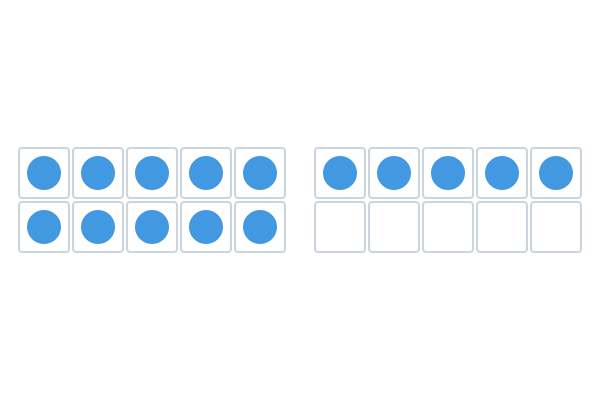
- 15
- 10
- 5
What is my child learning in Unit 7?
- Showing teen numbers as ten ones and some more ones, using ten-frames, drawings, and equations like 18 = 10 + 8. Learn more: Teen numbers as ten and some more
- Building and drawing models of shapes seen in the world, like a house or a tower. Learn more: Building and drawing shapes
- Putting shapes together to make larger shapes, like two squares that make a rectangle. Learn more: Putting shapes together to make new shapes
How you can help
- Draw a ten-frame on paper, fill it with 10 spoons, add a few more spoons beside it, and say the number, like "10 and 4 is 14."
- Build a tower or a house from boxes and large blocks, and name the shapes you used.
- Say a teen number, like 17, and ask your child to flash 10 fingers and then 7 more.
Where kids can get stuck
- Writing 71 for seventeen, putting the 7 first because they hear it first.
- Counting every object one by one instead of seeing a full ten-frame as 10.
- Thinking the 1 in 15 means just one thing, instead of one group of ten.
Practice makes perfect
Bobby's Math Club has practice problems that adapt to your child’s level, each with a detailed explanation and an easy-to-follow video, so your child can build confidence in these skills one step at a time.
Words your child will hear
- teen number
- A number from 11 to 19, made of ten ones and some more ones.
- ten-frame
- A box of 2 rows of 5 squares that shows 10 when it is full.
- ones
- Single things, counted one at a time.
- equation
- A number sentence with an equal sign, like 14 = 10 + 4.
- flat shape
- A shape that lies flat, like a square drawn on paper.
- solid shape
- A shape you can hold, like a block or a ball.
Ready to build your child’s confidence with teen numbers?
In Bobby's Math Club, your child practices teen numbers at just the right level, with a hint when they need one, a clear explanation after every question, and kid-friendly videos. Unlimited practice is free.
Join the clubCurious about your child’s level?
Take a free placement test →
Written by Robert “Bobby” Barnett
Bobby is an award-winning math teacher, the author of Meet Every Learner’s Needs, and the father of two elementary-school math learners. He uses Bobby’s Math Club with his own kids a few times every week. Learn more or contact Bobby.
Which math standards does i-Ready Classroom Mathematics Kindergarten Unit 7 cover?
i-Ready Classroom Mathematics Kindergarten Unit 7 covers these math standards. Each one links to what it means, sample questions, and teaching strategies.
For teachers: Unit names and order vary between editions and districts, so your school’s own materials have the exact sequence. Learn how Bobby's Math Club can help your students grow.